
Everybody obsesses over the hook. Then the viewer’s thumb stops, the first three seconds land — and the video has absolutely nothing to do for the remaining twenty-seven. I see this constantly in AI shorts: a gorgeous opening frame, a strong first line, and then a long slow drift where the character just… continues. Walks a bit more. Looks around. The video doesn’t end so much as give up.
Hooks get all the attention because hooks are where videos die publicly. But the middle? That’s where they die quietly.
A thirty-second AI video needs three beats, not one. A promise at the start, a turn in the middle that changes what the viewer thinks is happening, and a payoff at the end that makes the whole thing feel finished — or better, worth watching again. This isn’t screenwriting theory scaled down. It’s a practical generation plan, because in AI video every beat is a separate render with its own cost — and beats you haven’t planned are beats you’ll pay for twice. Here’s how I map the three beats, generation by generation, plus three beat maps you can lift outright.
Beyond The Hook: The Other 28 Seconds
Think of viewer attention as a loan. The hook borrows three seconds of it. Every second after that, the viewer is deciding whether to keep lending. You repay the loan in two installments: the turn, which says “this is not going where you thought,” and the payoff, which says “and it was worth it.” Skip the turn and attention leaks away around second ten — no matter how pretty the footage is. Skip the payoff and viewers finish the video feeling mildly cheated. Which on short-form platforms reads as a swipe and a quiet algorithmic shrug.
The good news: thirty seconds is a forgiving length. Long enough for a real miniature story. Short enough that you can generate every beat deliberately. The bad news: it’s exactly long enough that a single generated clip cannot hold it. Most AI clips live comfortably in the five-to-ten-second range — so a thirty-second story is three to six generations pretending to be one continuous piece. That’s why beats and generations should be planned together. Each beat gets its own board, its own prompt, its own reason to exist. The multi-shot storytelling approach covers the longer version of this thinking; here we’re squeezing the same discipline into half a minute.
Write your three beats as one sentence each before you touch a prompt. “A kid finds a robot everyone thinks is scrap (promise) — it opens its eyes only for her (turn) — it follows her home (payoff).” That’s a beat map. If you can’t write the turn as a sentence, you don’t have a middle yet.
Beat 1: The Promise (Seconds 0-3)
The promise is not the same thing as a hook, though they share real estate. The hook stops the scroll — a striking image, a face mid-emotion, a strange object, motion toward camera. The promise tells the viewer what kind of satisfaction is coming. A chef staring at a single perfect tomato promises a transformation: this will become something. A woman finding her own face on a missing-person poster promises a mystery. The viewer should feel the shape of the ending without knowing it.
Practically, the promise shot has three jobs and about three seconds to do them. It introduces the subject, it establishes the world — or at least the texture of it — and it plants the question the payoff will answer. That’s a lot for one generation. Which is why I prompt promise shots for clarity over cleverness: one subject, one clear visual idea, readable at phone size with the sound off. Save your complicated compositions for later beats, when the viewer is already invested and willing to look twice.
Motion helps. A still-like opening reads as a photograph, and photographs get skipped. Even a slow push-in or a subject entering frame gives the promise life. The dedicated guide to first-two-seconds hooks goes deep on stopping the scroll; the beat-planning point is simply this — hook and promise should be the same shot, doing both jobs, or you’ve spent your most valuable seconds twice.
Common failure I see in my own drafts: the promise promises the wrong video. I open on the most spectacular frame I generated — but the story is actually about something smaller and better. Viewers feel the mismatch by the payoff even if they can’t name it. Put the spectacular frame where it belongs in the arc. Let the promise be honest.
Beat 2: The Turn (The Middle Nobody Plans)
The turn is the beat that changes the viewer’s understanding. Something is revealed, reversed, escalated, or complicated. The stray dog the kid has been feeding turns out to be wearing a collar with her own address on it. The “easy” recipe the chef is demonstrating requires an ingredient that is still alive. The product that looked like a gimmick does the one thing nobody expected. Twists in the clever literary sense are optional. A change of direction is not.
Why does nobody plan it? Because in AI workflows the middle beats are usually generated first (they contain the “main content”) — and they get generated as demonstrations rather than story. A middle that demonstrates shows more of the same: another angle, another moment, the process continuing. A middle that turns gives the viewer new information that recolors everything before it. The test I use on a storyboard: cover the promise panel with your hand and read the middle panel. Does it still make sense as a continuation — or does it introduce something you didn’t know? If it’s only continuation, it’s not a turn yet.
Turns divide roughly into four flavors, and all four generate well:
- The reveal. The camera or the character discovers something hidden: a door, a face, an object, a second character. Reveals are AI-friendly because they are single shots with a clear subject.
- The reversal. The situation flips — hunter becomes hunted, helper becomes problem, junk becomes treasure. Strong, but needs the clearest storyboarding so the flip reads without dialogue.
- The escalation. The stakes visibly grow: the small fire is now a big fire, the one follower is now a crowd. Escalation builds toward payoff naturally.
- The complication. A new obstacle arrives that blocks the obvious ending. Best for comedy and for stories that will pay off with a solution.
Timing-wise, the turn belongs roughly between seconds 8 and 18 in a thirty-second piece. Earlier and the promise hasn’t settled. Later and the payoff gets squeezed into a breath. When I’m cutting in Premiere Pro and a video feels saggy, nine times out of ten the turn is landing too late — I drag the whole middle earlier, trim the promise’s tail, and the piece wakes up. Structure problems often disguise themselves as pacing problems. The fix is the same: turn sooner.
Beat 3: The Payoff That Earns The Replay
The payoff answers the promise. Ideally with a small surplus — the ending is what was promised, plus one thing more. The robot stands up (promised: it is alive) and picks up the kid’s dropped backpack (surplus: it has decided something). That surplus is what generates comments, shares, and replays — because it gives the audience a thought to carry out of the video.
Payoffs fail in two directions. The undercooked payoff simply stops: the process completes, the character arrives, nothing lands. The overcooked payoff tries to add a second twist, a text card, and a logo sting in four seconds — and lands none of them. The sweet spot is one clear image or action, held a breath longer than the other beats. I deliberately generate the payoff shot a little long and let it breathe in the edit — the only beat I don’t trim aggressively — because the ending is where the viewer’s final judgment forms. Last impressions aren’t a metaphor on short-form. The replay button gets pressed or not in the half-second after your final frame.
If you want the replay specifically, end on an image that rhymes with the opening: same framing, transformed content. The empty junkyard corner, now with a robot sitting in it waiting. The viewer’s brain wants to check the difference — and the easiest way to check is to watch again. That looping instinct gets its own full treatment in storyboard-first planning generally and in the endings guide in this same series. For beat purposes, just know this: the payoff and the promise should be designed as a pair, ideally boarded side by side.
Sound matters here more than creators expect. A payoff with a small audio signature — a chime, a laugh, a door closing, the first note of music that has been withheld — marks the ending in the viewer’s body. I often hold back the warmest sound in the piece for the payoff. Silence breaking is a payoff. So is music stopping dead on the final frame. Pick one. On purpose.
Mapping Beats To Generations: One Beat, One Board
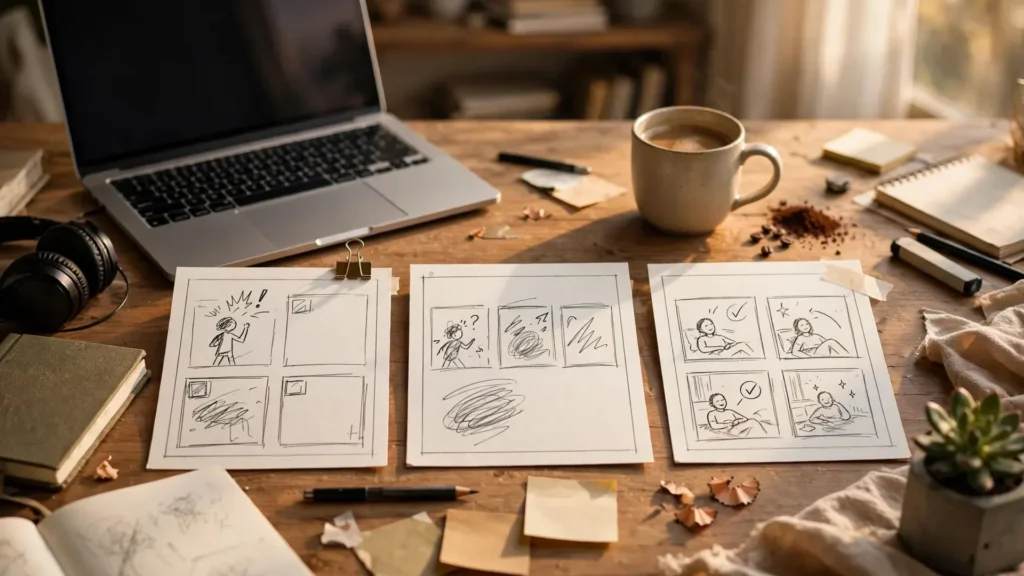
Here’s the workflow in its most practical form. For each beat, I make one storyboard panel (or one still image) that captures the beat’s single job — and I get that panel right before generating motion. The panel for the promise must read instantly. The panel for the turn must contain the new information visibly — if the turn is a reveal, the revealed thing is IN the panel, not implied. The panel for the payoff must feel like a final frame. The one you’d pick as the thumbnail of the ending.
Then generations map to beats like this:
- Promise: one generation, usually image-to-video from the opening panel so the first frame is exactly the hook I designed.
- Turn: one or two generations. If the turn is a reveal, one shot with the reveal inside it. If it is an escalation, two shorter shots that grow.
- Payoff: one generation, generated long, trimmed late.
- Connective shots: only if the jumps between beats confuse. A two-second linking shot is cheaper than a confused viewer, but add these last and reluctantly — most thirty-second stories cut cleaner than creators fear.
This changes the economics of the whole piece. When a beat fails, you regenerate one beat — not the video. When the turn tests weak with a friend watching over your shoulder, you redo the turn panel on paper for free. And because each generation has one dramatic job, your prompts get shorter and clearer almost by themselves: “she sees the robot’s eyes open” is a prompt. “The middle part where things develop” is not.
Character anchors stay constant across all beats — same reference images, same wardrobe wording — and I check the three beat panels side by side for face and costume agreement before spending a single generation. Beats can change everything about a story except who is in it.
Three Beat Maps You Can Steal: Story, Product, Comedy
Story map — “The Night Bus.” Promise (0–4s): a tired driver on an empty night bus, one passenger asleep in the back. Turn (4–18s): at each stop, the sleeping passenger is somehow in a different costume — chef, bride, astronaut — while the bus stays empty. Payoff (18–30s): the final stop, the passenger wakes as a tired bus driver, walks to the front, and relieves our driver, who goes and sits in the back and falls asleep. Three beats, five or six generations, no dialogue — and the ending recontextualizes everything.
Product map — “The Leaky Bottle.” Promise (0–3s): a gym bag opened to reveal everything inside soaked. Turn (3–18s): the new bottle takes the abuse — dropped, squeezed, frozen, rattled in the bag on a run — shown in quick escalating tests. Payoff (18–30s): same gym bag, same opening shot as the promise, everything bone dry, bottle pulled out with a small satisfied shake. The product arc in this series goes deeper on proof shots; notice here how the turn is really a stack of small escalations, which keeps the middle generating cleanly.
Comedy map — “The Helpful Cat.” Promise (0–4s): a man sneezes; his cat watches, concerned. Turn (4–20s): the cat “helps” — dragging over a tissue box, then a blanket, then a bowl of soup, each offering bigger and less appropriate, escalating through three quick beats. Payoff (20–30s): the man, buried under offerings, sneezes again; cut to the cat dragging in a full first-aid kit and a tiny nurse’s cap. Comedy lives and dies on the turn being a stack rather than a single gag — one joke is a moment, three escalating jokes are a story.
Steal the shapes, not the subjects. Each map is really just: here is a person and a situation, here is the thing you didn’t expect, here is the image you’ll remember. Write yours in three sentences. Board one panel per beat. Generate beat by beat — and trim late everywhere except the ending. Thirty seconds stops feeling like a constraint very quickly. It starts feeling like exactly enough room to make someone feel something. Which is the whole job.