
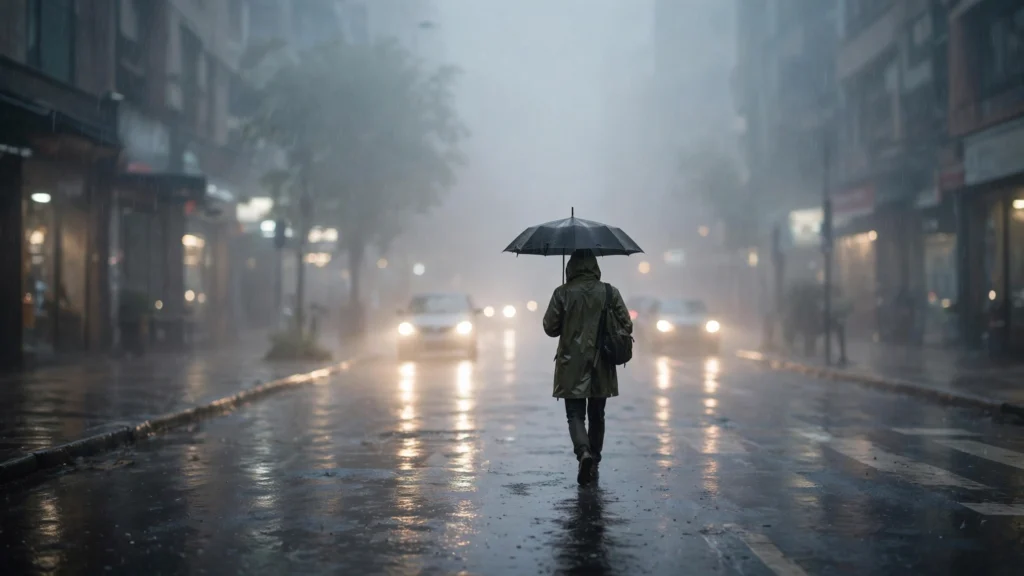
Weather is the fastest mood a prompt can buy — and the fastest way to ruin a shot. Ask for rain and half the time you get a grey veil over everything. Faces soft, contrast gone. The infamous mush. Ask for fog and the model hands you a white room.
But the problem is rarely the weather itself. It’s how we describe it. Creators prompt weather as a mood word — “rainy, atmospheric, moody” — and the model smears mood across the whole frame evenly. Which is precisely what real atmosphere never does.
Real rain lives on surfaces. Real fog eats the distance and spares the foreground. Real dust hangs in light beams and nowhere else. On our storyboards, weather gets drawn as three layers — near, mid, far — before it gets written as words. Because atmosphere is a depth device first and a decoration second.
This guide goes weather by weather. What each one actually does to a frame, the prompt language that keeps it physical, and the restraint that keeps it out of the mush.
Atmosphere Is Depth, Not Decoration
Stand on any real street in rain or fog and notice what your eyes report. The person two metres away is crisp. The shop across the street is softer and lower in contrast. The end of the street is a suggestion. Atmosphere grades the world by distance.
That gradient is information. It tells the viewer how big the space is and where they stand in it. When a model applies weather evenly — near and far equally veiled — the depth information dies, and the brain files the shot as fake.
So the first fix is structural: describe weather per layer, even briefly. “Sharp foreground, rain streaks close to camera, midground softened, background fading into mist” hands the model a distance map. You’ll see this layer language return in every section below. Because it works for all of them.
The second fix is material. Weather must touch things. Rain needs splash, drip, shine, soaked fabric. Fog needs something to wrap around. Dust needs a beam to live in. Weather that touches nothing is a filter — and viewers can always tell a filter. Our storyboard-first workflow treats weather as a location decision: it’s drawn on the board, layered, before any prompt inherits it.
A dose note, because it governs everything below. Atmosphere scales inversely with shot length. A wide establishing shot can carry heavy fog; a close-up under the same fog has nothing left to show but grey. Board the heaviest atmosphere in the widest shots and let it thin as you move in. Real weather doesn’t thin, of course — but real cameras also move closer under the same sky and still resolve the face, because the near layer stays clear. Prompting “foreground stays clear and detailed” achieves the same honesty.
Rain: Surfaces, Splashes And Sound Thinking
Rain is the most requested weather and the most physically demanding. Because rain isn’t one effect. It’s at least five: streaks in the air, impacts on surfaces, runoff and drips, soaked materials and darkened colors, and reflections on wet ground. A generation that includes three of the five reads as rain. A generation with only streaks reads as a screensaver.
When I prompt rain, I spend words on the ground and the clothing before the sky. “Rain hammering the pavement, splashes on the stone steps, her coat darkened and heavy with water” gives the model evidence at every depth.
Phrasing that holds up in Seedance 2.5 and Veo:
- “steady rain, visible streaks against the dark background, splashing on wet pavement, reflections in puddles” — the streaks need a dark backdrop to read against; against a bright sky they vanish or turn to noise.
- “light drizzle, fine mist of rain, droplets on his jacket shoulders, street shining” — drizzle is a surface story more than an air story.
- “rain beading and running down the window glass, city lights soft beyond, interior warm and dry” — rain on glass is the safest rain of all: the model renders droplets on a plane beautifully, and the character stays dry, sharp, and actable.
Faces and rain are uneasy partners. Falling rain crossing a face at close range invites artefacts — streaks that stick to skin, droplets that morph. Keep faces under cover (“under the awning, rain sheeting off its edge”), keep rain shots shorter than dry ones, and let hands and shoulders take the weather.
Also think about sound, even in silent generations. Rain implies a sonic world. And if the finished piece will carry audio, a shot composed for rain — hoods, umbrellas, awnings, people hurrying — accepts a rain track in the edit far better than a calm shot with rain noise pasted over it. Board for the mix, not just the frame.
The reject pile teaches the main lesson. Rain generations fail mushy when the prompt majors in “stormy mood” and minors in surfaces. Swap the ratio and the same model, same seed family, suddenly photographs weather.
Fog: Layering Near, Mid And Far
Fog is atmosphere with the volume up. And it obeys one law above all: contrast dies with distance. Blacks lift to grey, whites dim, edges soften — in order, farthest first. A correct fog prompt is therefore a set of instructions about what remains visible. “Thick fog” alone tells the model to hide everything equally — including your subject, standing right there.
Write fog in layers. Explicitly:
- “early morning fog; foreground fence posts sharp and dark; the field softening into pale grey; treeline barely visible, a faint silhouette” — three layers, three contrast levels, one sentence.
- “fog at ankle height over the wet field, clear air above” — ground fog is the most cinematic and the most forgiving, because faces live in the clear band.
- “harbour fog, lamp glows blooming in the mist, masts fading upward” — fog plus practicals: every light source gets a halo, which is beautiful and also a depth ruler, since nearer halos stay tighter.
Movement helps fog enormously. A slow push-in through layered fog gives the model (and the viewer) changing parallax to read. Fog shots held static for long durations tend to boil subtly — the mist churns because the model keeps repainting it. Short, slow, and layered is the reliable recipe.
Color discipline matters too. Fog is the color of its light. Dawn fog is pearl and pink at the edges; night fog around sodium lamps is amber; midday fog is honest grey. Name the light and the fog follows. If the location has an established light line from your lighting prompts for AI video work, the fog inherits it — one more reason weather belongs on the location sheet.
Dust, Smoke And Haze: The Subtle Professionals
If rain and fog are weather, dust and haze are craft. The atmosphere you add when the weather is fine. A thin haze in a sunbeam through a workshop window. Dust motes drifting in a projector’s light. Woodsmoke hanging over a morning village. These read as expensive because they prove the air has volume and the light has somewhere to land.
Professionals call the visible version “atmosphere” on set, and they spray it precisely so beams show up. Your prompt can do the same.
The keywords are restraint words: “thin haze”, “faint dust in the light”, “a trace of smoke”, “soft atmospheric depth”. Pair every particle with its light source — “dust motes drifting in a shaft of window light” — because unlit atmosphere is just fog with better PR. Smoke needs a source and a behavior: “woodsmoke curling from the chimney, drifting sideways in still air” gives the model an origin and a direction. And smoke without an origin is another classic mush trigger.
Where these shine in short-form work: interiors that would otherwise look airless (a shaft of haze turns a plain room into a place), product shots needing scale in the background, and any backlit scene where the rim light wants something to catch. The failure mode is greed. Haze plus fog plus rain plus golden flare is a soup recipe. Pick the one atmosphere the shot is about.
A shot can have a star the same way a scene can. Atmosphere supports — it does not headline twice.
Wet Streets And Reflections
Wet ground deserves its own section. Because it’s the highest-value weather effect per word in AI video. A rain-soaked street does three jobs at once: it proves the weather without a single falling drop, it doubles every light source into a reflection (instant production value), and it darkens asphalt and stone so colors and practicals glow harder against them.
Night plus wet pavement is the most reliably cinematic combination most creators will ever prompt. I’m not exaggerating.
Reliable phrasing: “wet street after rain, puddles mirroring the neon signs, dark glossy asphalt”. Note the tense trick — “after rain” buys you the reflective world without asking the model to animate falling rain across faces. During-rain wets are fine for wides; for anything with a face you care about, post-rain is the professional’s shortcut, and nobody has ever felt cheated by it.
Reflections need sources. So pair the wet ground with something to reflect: signs, lamps, headlights, a bright doorway. “Wet pavement” alone reflects a grey sky and looks like a parking lot at noon. Give it color to double.
Daytime wet has its own use too. A street washed clean after a storm, everything saturated, sun returning — “just after rain, wet stone shining, colours deep, first sunlight breaking through”. Models love this one because contrast and color are both high. Either way, check reflections in review: mirrored signs with garbled text are acceptable at a glance (and can be kept text-free by prompting “abstract glowing signs”), but a reflection that moves against its source is a re-roll. In Premiere, a half-second trim often saves the shot before the reflection misbehaves — another reason these shots earn their keep in the edit.
One Weather Idea Per Shot, Fully Committed
Everything above reduces to a discipline I enforce at the board: one weather idea per shot. Chosen deliberately. Described physically. Layered by distance.
The shot is about rain on glass — then the glass gets the words. The shot is about fog depth — then the layers get the words. The moment a prompt tries to be about rain and fog and wind and mood, each effect gets a quarter of the model’s attention, and the frame gets the mush.
A quick pre-generation checklist that has saved me many credits:
- Can I name the weather’s star surface? (Pavement, glass, shoulders, ground fog over a field.) If not, rewrite.
- Is the foreground promised clarity? Say it: “foreground sharp, weather thickens with distance”.
- Is there a light source for the atmosphere to interact with? Beams, halos, and reflections are atmosphere made visible.
- Does the shot length suit the weather? Heavy atmosphere, wide and short. Faces, light weather or none.
- Does the weather match the sequence’s locked light line — same time, same sky, same wetness in shot four as shot one? Wet streets that dry between cuts are the mismatch viewers catch.
Weather done this way stops being a gamble and becomes what it is on real shoots: a production design choice with a cost and a payoff. It’ll still surprise you — models render atmosphere with real enthusiasm once the structure is right — but the surprises turn pleasant.
Commit to one idea. Describe what it touches. Let the layers do the rest.