
Every AI video creator has a private folder of almost-great shots ruined by one hand. The face held. The light was right. Then the character reached for a cup and the cup became part of the hand, or the hand grew a sixth finger on its way to the table, or two hands merged into one polite knot around a phone. Hands, eating, and every kind of touch sit at the top of the failure charts for a reason: contact is where a model has to solve physics, anatomy, and intention at the same time, in public, frame by frame.
I’m not saying that to scare anyone off these shots. My own work needs them — people pick things up, pass things, eat, work with their hands. A story told entirely in hands-free medium shots looks evasive, and audiences smell it. The answer isn’t avoiding contact. The answer is staging contact in words the way you’d stage it on a board: explicitly, slowly, simply, with every touch point named. That’s what this guide is for.
Contact Is Choreography
The mindset shift that fixed my contact shots was stealing a word from dance. Contact is choreography. A hand approaching a cup isn’t one event. It’s a sequence of small, drawable positions: hand rises, hand travels, fingers open, fingers close around the handle, lift. A model handed the word “grabs” has to invent all five positions and the transitions between them, at speed, while also maintaining a face. A model handed the sequence in compressed form — “lifts the cup by its handle” — still invents the transitions, but now it knows the grip, the contact point, and the destination. The invention left to it shrinks. And the melt shrinks with it.
Choreography also implies rehearsal limits. Choreographers don’t ask a dancer for a leap, a catch, and a spin in one count and then blame the dancer. When I board a contact shot now, I draw the grip before I draw anything else: which hand, which part of the object, fingers over or under, object resting or suspended. If I can’t draw the grip as one clear still, the shot isn’t ready to generate. That single rule, borrowed straight from the storyboard habit, has saved me more generations than any negative prompt ever written.
Speed is the choreographer’s other lever. And it’s yours too. Contact rendered slowly gives the model more frames to maintain the relationship between hand and object. The same pickup at half speed isn’t slightly easier. It’s a different class of solvable. Nearly every pattern later in this article has “slow” baked into it — not as a mood choice, but as physics insurance.
Finally — choreography means the contact must be the point of the shot. A pickup buried inside a walking, talking, camera-moving generation is a contact the model will sacrifice to the larger motions. Promote it. Give the pickup its own framing, its own beat, its own quiet half-second before and after. Hands survive when the shot is about them. They’re expendable extras in shots about everything else.
Name Every Touch Point
Vague contact language is the root failure. “Holding a cup” doesn’t say where the holding happens. The model must choose: handle, body of the cup, from above, from below, one hand, two. It chooses differently across frames — and different choices across frames is precisely what morphing is. Your prompt can remove the choice by naming the touch points in plain anatomical and mechanical words.
The naming habit has three parts. Which hand. “Her right hand,” not “a hand.” In two-handed actions, name both jobs: “left hand steadies the bowl, right hand lifts the spoon.” Hands that have assigned jobs swap less. Which part of the object. Handle, rim, edge, stem, lid, corner — objects are gripped at features, and features give the model anchors. What kind of contact. Wrapped around, pinching, cradling from below, pressing flat, resting on top. Each phrase describes a different finger arrangement, and finger arrangement stated is finger arrangement halfway rendered.
Watch the difference in practice. Weak: “A man holding a smartphone, looking at it.” Workable: “A man holds a smartphone in both hands at chest height, thumbs resting on the lower edge, screen facing him.” The second version isn’t longer by much, but every touch point is assigned: both hands, chest height, thumbs placed, orientation fixed. The model’s remaining job is tiny motion — a scroll, a slight tilt — instead of continuous re-invention of the grip.
Touch points between people need the same treatment, doubled. “They shake hands” becomes “they clasp right hands, one firm shake, forearms level.” “She hands him the keys” becomes “she holds the keys out in her open right palm; his left hand takes them.” The second version is nearly a storyboard caption — and that’s exactly the register contact prompts should be written in. If two bodies must touch, describe the touch as a meeting of named parts with a named duration, and keep the duration short.
Supporting contact counts too, and it’s often the cheat that saves a shot. A hand resting flat on a table while the other hand works. An elbow on the counter. A back against a wall. Resting contact stabilises a body in the frame and gives the model fixed relationships to maintain instead of free-floating limbs to supervise. In my own boards, I look for one resting contact in every hand shot, the way you’d anchor a wobbly table. Stillness at one point buys believable motion at another.
Slow Hands, Simple Grips
If naming touch points is the grammar, slowness and simplicity are the pronunciation. Say them clearly or the sentence slurs.
Slow, stated directly against the verb: “slowly lifts,” “gently sets down,” “eases the lid open.” I used to add pace words as decoration. For contact shots I add them as engineering. A slow lift keeps the object in the hand’s neighbourhood for more frames, small errors stay small, and the eye — which forgives slowness and punishes speed in generated hands — has time to accept the relationship. Fast hand motion is where extra fingers breed, because the model is drawing motion blur with anatomy it hasn’t resolved. Slow it down and you’re asking for portraits of a grip instead of guesses at one.
Simple grips beat capable ones. The hierarchy I trust, from safest to riskiest: palm-down resting contact, two-handed cradles, whole-hand wraps around chunky objects, handle grips, pinches, single-finger work, interlaced anything. Typing, piano, sign language, tying laces, counting coins — the far end of that list — should be treated as specialist shots: generate them as the entire point of the clip, short, close, and with a discard budget, or stage them out of frame and let sound imply them.
Choose objects that forgive. A mug with a handle is a friendlier prop than a stemmed glass. A book is friendlier than loose papers. A whole fruit is friendlier than a handful of berries. When I have freedom in a board, I cast the prop the way I’d cast an actor — for reliability under pressure. The audience will never know the glass became a mug. They would have known about the sixth finger.
One more simplification that earns its keep: reduce the hand’s travel distance. A hand that enters frame, crosses the body, grasps, lifts, and carries is five chances to fail. A hand already near the object, grasping and lifting six inches, is two. Board the hand close to its job. Pre-position on the still, spend the generation on the grip and the small lift. This is the contact version of starting mid-motion, and it works for the same reason: the model is never better than at sustaining a relationship it was handed at frame one.
Eating: The Boss Level Of Contact
Eating combines every contact hazard at once: hand-to-object grip, object-to-mouth travel, mouth contact, a bite that changes the object’s shape, chewing motion, and a face that must stay itself through all of it. It is, shot for shot, the hardest ordinary thing creators ask models to do. Respect it as a boss level and it becomes beatable. Ask for it casually inside a busy dinner scene and it’ll take the whole generation down with it.
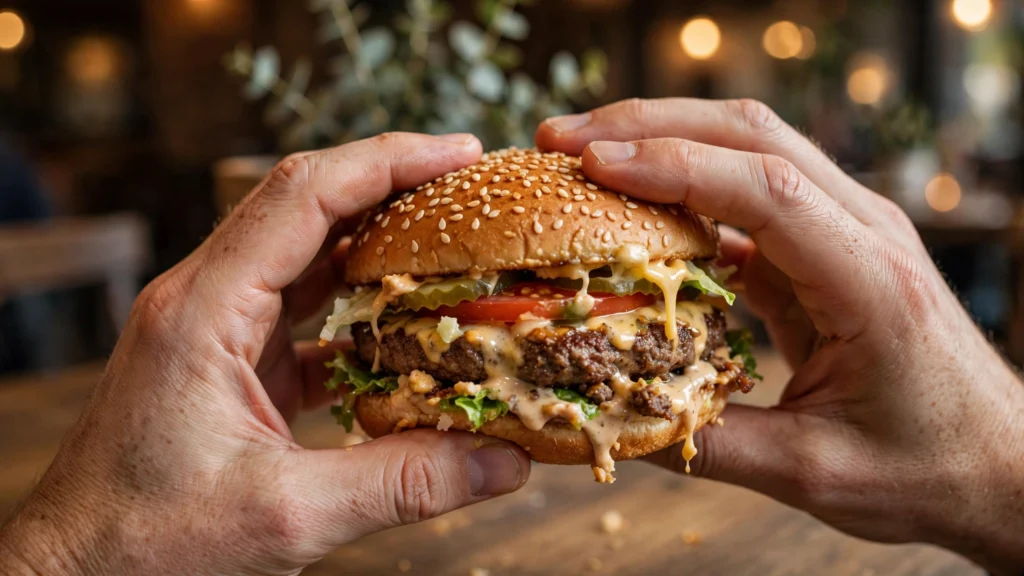
What actually works is reducing eating to its most legible, lowest-contact beat. The winners from my own testing: the moment before eating — food raised, paused, the decision visible; the first small bite on a sturdy food, close and slow; and the reaction after — chewing gently, eyes up, the taste landing. The full journey from plate to mouth to bite to chew to swallow, in one unbroken generation, remains a lottery ticket even in strong models. Board around the journey. The cut from “raises the fork” to “chewing, pleased” loses nothing a viewer wanted and skips every frame where the melt lives.
Food choice is casting, again. Foods on handles — a skewer, a drumstick, an ice cream cone, a sandwich held in both hands — give hands a simple, sustained grip and keep fingers away from the mouth. Loose, small, multi-piece foods — salads, noodle bowls, handfuls of snacks — multiply contacts and shape changes. Utensils sit between: a fork arriving at the mouth is one clean contact, but loading the fork is a small engineering project. When the board lets me choose, the food on a handle wins, and the acting beat is carried by the eyes anyway.
Drinking from a cup with a handle, or a bottle, behaves similarly to eating on a handle: one grip, one tilt, contact at the lips that can be kept brief and slightly angled away from full frontal. Straws complicate the mouth. Open glasses complicate the grip and add liquid physics. Keep the drink simple, the tilt shallow, the sip short — and consider that the set-down after a sip is an easier hero shot than the sip itself. A cup placed down with a small exhale of satisfaction tells the audience the drink was good without surviving mouth contact at all.
Pace and framing for eating follow the contact rules at full strength: slow, close enough to see the grip but not so macro that teeth and texture dominate, short duration, the bite as the single action of the shot. And run your frame-by-frame quality check on eating shots without mercy. Artefacts that pass at playback speed — a fork softening, a bite that heals — are obvious the moment a viewer pauses, and eating shots invite pausing because viewers study food. If the contact doesn’t hold under scrutiny, cut earlier. The audience will imagine a better bite than the model rendered.
When To Keep Hands Out Of Frame Entirely
The professional skill underneath all of this is knowing when the answer is a different shot. Some beats shouldn’t contain hands, and recognising them at the board is cheaper than discovering them at the discard pile.
Keep hands out when the beat is emotional and the framing is a close-up. A face listening, deciding, reacting — hands entering to gesture will tax the face’s stability for expressiveness the eyes were already delivering. Keep hands out when the action can be completed off-screen between cuts: the character reaches down out of frame, cut, the object is in hand. The audience’s brain performs that pickup flawlessly and at no cost to you. Keep hands out when the object is small, detailed, or text-bearing — keys with tiny teeth, coins, cards, jewellery, anything with lettering. Off-screen handling plus a sound effect plus the object revealed resting in an open palm (a held state, pre-positioned) covers nearly all of it.
There’s a composition habit that makes hands-out shots feel intentional rather than evasive: commit to the framing. A confident close-up on a face, a clean over-shoulder where the foreground shoulder is a soft shape, a medium shot cropped at the waist for a walking beat. What reads as avoidance is the almost-shot — hands half-in at the frame edge, nibbling at an object the camera refuses to show properly. Either stage the contact as the subject, or frame it out completely. The half-measure is where viewers start hunting for the trick.
I’ll be honest about the trade-off, because pretending otherwise helps nobody. A diet of hands-out shots narrows the kinds of stories you can tell, and pushed too far it produces that weightless, mannequin feeling people associate with AI video. The goal isn’t zero contact. It’s budgeted contact: one honest contact beat per sequence, staged properly and paid for properly, surrounded by shots that imply handling without rendering it. Films ration their hardest shots the same way. One good pickup that holds will convince an audience the whole world is touchable. Three melted ones will convince them of the opposite.
Prompt Patterns For Pick Up, Hold, Pour And Pass
Four contact verbs cover most of what stories actually need. Each pattern below assumes the shot exists for the contact, the hand starts near the object, and the pace word is doing engineering work. Adapt the objects. Keep the structure.
Pick Up. “Close on her right hand resting beside the mug. She slowly wraps her fingers around the handle and lifts the mug a few inches off the table. Locked-off camera.” The hand begins in frame, at rest, adjacent — three gifts to the model before the verb even starts. The lift is deliberately small. Height isn’t the point; the grip is.
Hold. “He holds the envelope in both hands at waist height, thumbs along its top edge, looking down at it. Slow push-in.” Holding is a state, and states are the safest contact there is. Give the hold a duration job — he is reading, deciding, waiting — and the stillness becomes acting instead of a frozen frame. This is also the pattern for product-in-hand shots where the object must survive inspection.
Pour. “She tilts the jug slowly, a thin stream of water pouring into the glass below, her other hand steadying the glass at its base.” Pouring asks for liquid, tilt, and a steadying contact, so it needs every simplification available: thin stream, slow tilt, second hand assigned to stillness, and a target vessel that’s chunky and clear of the hand. Board the end of the pour — the set-down or the first sip belongs to the next shot, per the boss-level rules.
Pass. “He holds the book out in his right hand. Her left hand takes it, fingers closing over the cover, and he releases it. Medium close-up, slow and brief.” The pass is two grips and a transfer, so name both hands, name the order, and let the release be implied by her secured grip rather than described mid-air. The most reliable pass is often the incomplete one: he extends, cut, she holds the book. Two held states and an edit will outperform one rendered transfer on most days, and they cost less dignity when they fail.
Across all four patterns, two supporting habits pay rent. First, a short, targeted negative prompt for hands and objects on contact shots — malformed fingers, extra digits, object warping — used as a fence, not a rescue. The negative prompts guide covers building those fences properly. Second, generate contact shots at the shortest duration that contains the beat. Contact decays with time in frame; a four-second pickup has fewer frames in which to come apart than an eight-second one carrying dead air on both ends.
The closing thought is the one I give creators who send me their melted footage: your models aren’t bad at hands because they’re bad. They’re bad at unnamed, unpaced, unstaged contact — contact that even a careful human performer would need blocked and rehearsed. Name the touch points. Slow the hand. Simplify the grip. Draw the grip on the board before you type it in the prompt. Do those four things and the shots that break first will start surviving — not every time, but at a rate that lets you build stories with hands in them, which is the only rate that matters.