
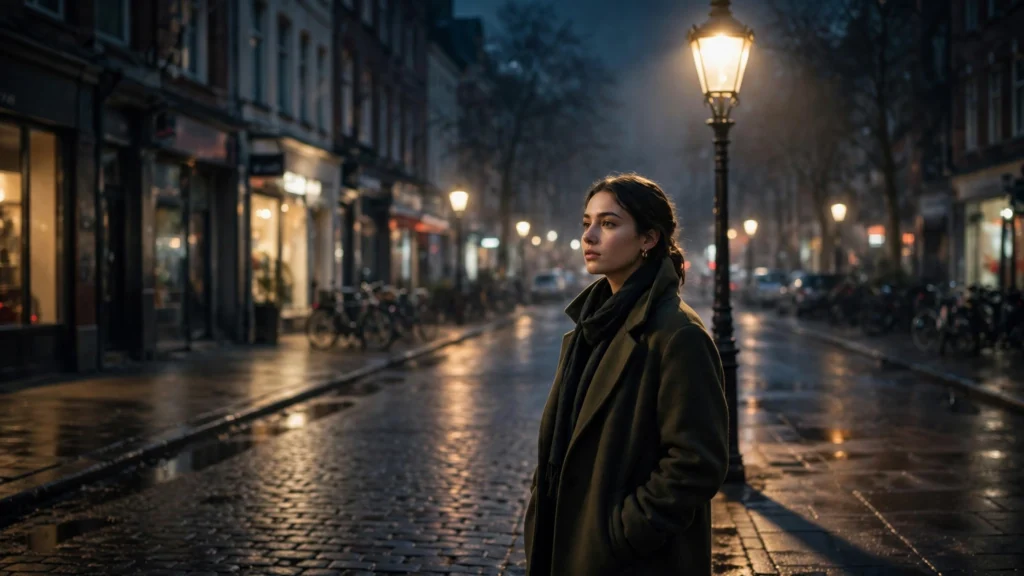
Prompt “a dark night scene” and the generator hands you one of three failures. A noisy mess that looks shot through a dirty sensor. Shadows crushed to a single black. Or — my favourite — a scene that’s secretly daylight wearing a blue tint.
Night defeats naive prompts because night isn’t the absence of light. It’s a different exposure problem. Real night footage holds bright pools where the lights are, clean dark where they aren’t, and readable faces inside a stop or two of shadow. That’s a distribution problem, not a darkness problem. And it can be prompted like one. In our pipeline, night boards are drawn deliberately a stop brighter than the intended final look — and the darkness gets finished in Premiere, where it can be controlled. Generation-for-the-grade is the professional move here. The prompts below are written for it: exposure language first, mood second.
Night Is Exposure, Not Darkness
Start with what a camera actually does at night. Exposure is a budget: the sensor gathers what light exists, and the image-maker decides what to spend it on. Spend it on the highlights, shadows go black. Spend it on shadows, highlights blow out. Real night cinematography spends it in the middle — practical lights hot but holding detail, faces exposed properly, shadows allowed to be dark but never empty. The blacks in great night footage are rarely pure black. They’re deep, quiet tones with just enough information to feel like a place rather than a void.
Generated video fails differently: the model tries to satisfy the word “dark” globally, underexposing everything, then letting compression noise fill the shadow areas. That’s where the grit comes from — not from darkness itself, but from darkness without information. The fix is to stop asking for darkness and start describing distribution: where the light pools are, what the faces are doing, what the shadows retain. “Night street, pools of warm lamplight, faces lit as they pass through the light, shadows deep but clean” will beat “dark moody night” every single time — because it answers the questions the model was guessing at. The broader source-first thinking is the same as in our lighting prompts for AI video guide; night just raises the stakes on it.
One honest consequence: a well-exposed night generation will look slightly too bright on first viewing, especially on a phone in a lit room. That’s correct. You’re generating the negative, not the print. Judge it by whether the shadows are clean and the faces hold — not by whether it feels dark yet. The feeling of darkness is a finishing job, and it’s a five-minute one when the source material is clean.
Pools Of Light: How Real Night Looks
Walk a real street at night and your eye moves pool to pool: the cone under a streetlamp, the spill from a shop doorway, headlights raking across a wall, then a stretch of near-black between. Night is archipelagos of light in a dark sea, and the sea matters as much as the islands — it’s what makes the islands read as night rather than evening. Generated scenes that fill every corner with dim visibility lose exactly this. Uniform dimness reads as a badly lit day.
Prompt the archipelago. Give the scene two or three named pools with dark water between them: “a quiet street at night; warm pools of lamplight every few metres; deep shadow between the pools; a lit bakery window at the end of the street”. The phrase “between the pools” is the workhorse — it explicitly licences true shadow, which models hesitate to render unless told it’s wanted. Practicals do double duty here, as they always do: the visible lamp justifies the pool and caps its brightness. A pool without a source floats; a pool under a lamp sits down and behaves.
Movement through pools is a gift to editors. A character walking pool to pool gives you natural exposure beats — bright, dark, bright — that cut beautifully against music or dialogue and hide edit points in the dark passes. I board night walks this way on purpose. And one small technical note for review: judge pool edges, not pool centres. Centres are easy. The edge — where light falls off into shadow smoothly instead of in a hard ring or a noisy band — is where generations confess.
Skin And Faces After Dark
Faces are where night generations go to die. Skin at night asks the model for its hardest trick: warm, dim, detailed, and clean, all at once. What typically arrives is either a face lit like a passport photo pasted into a dark scene, or a face that dissolves into grain the moment it leaves the light. The middle path gets described, not hoped for: name where the face’s light comes from and how strong it is, and keep faces inside or near a pool for any shot longer than a glance.
Reliable arrangements, in the order I reach for them:
- Face at the edge of a pool. “Her face half in lamplight, half in soft shadow, detail held on both sides.” Edge light models a face; full frontal darkness flattens it. The held-detail clause does real work.
- Source-below faces (screens, candles, dash lights). “Face lit from below by a phone glow, warm dashboard light beyond.” Intimate and unmistakably night; models render it well because phones-at-night is heavily represented in real footage.
- Rim and backlight with a whisper of fill. “Streetlamp behind him, bright rim on his shoulders, face in soft shadow with faint reflected light from the wet pavement.” The wet-pavement bounce is a classic cheat — it gives shadow-side faces a reason to be readable.
Keep night close-ups short and keep performance simple. Every second a face spends in low-light rendering is a second for noise and identity drift to accumulate. Cutaways — hands in lamplight, the street itself — relieve faces and are often the more memorable shots anyway. Consistency across a night sequence deserves its own check: our AI video QC checklist treats face exposure drift between night shots as a named defect, because a face that’s bright in shot two and buried in shot three breaks the scene faster than any shadow error.
Prompt Words For Clean Shadows
Here’s the exposure vocabulary that moves the needle, grouped by job. These phrases work in Seedance 2.5 and Veo; treat them as dials — change one per re-roll.
- For shadow quality: “clean shadows, no noise”, “smooth shadow falloff”, “deep shadows with detail retained”. The negative “no noise” genuinely helps — models have a label for sensor noise and can suppress it when told it is unwanted.
- For overall level: “exposed for the highlights”, “low-key lighting, mostly shadow with bright accents”, “night scene shot on a fast lens, shallow depth of field”. Low-key is the professional term for a mostly-dark frame with deliberate bright areas, and models know it.
- For face protection: “face correctly exposed”, “skin tones warm and natural in the lamplight”. “Correctly exposed” sounds bland; in practice it instructs the model to prioritise the face over the mood.
- For highlight control: “lamps bright but holding detail, not blown out”, “neon glow contained, edges crisp”. Uncapped sources are the number one cause of the night blowout failure.
- Words that reliably hurt: “very dark”, “pitch black”, “ultra moody”, stacked together. Each pushes global underexposure, which is the mush recipe. One mood word at the end of a well-built exposure description is fine; three at the start is a hole you climb out of all generation.
A full example, before and after. Before: “dark moody night alley, man waiting, cinematic.” After: “Night alley between two pools of light: a warm lamp above a doorway behind him and cool light spilling from a side street. A man waits at the edge of the lamplight, face half lit, detail held in the shadow side, clean deep shadows, wet stone reflecting the lamp. Low-key, photorealistic.” The second prompt is longer, but every clause is an exposure decision the model no longer has to invent — and invention, at night, is where the noise lives.
City Night Vs Country Night
City and country nights are different exposure worlds, and mixing their vocabularies is a quiet cause of fake-looking results. City night is never truly dark: skyglow lifts the shadows to dark blue-grey, sources are everywhere (sodium amber, LED white, neon colour, headlight beams), wet surfaces multiply them. The prompting palette is source-rich: name the mix and let the skyglow do the shadow fill — “city night, deep blue skyglow, warm and cool light sources mixed, shadows lifted slightly by ambient glow”.
Country night is the opposite bargain: one or two sources at most — a farmhouse window, moonlight, a porch lamp, stars if the frame earns them — and darkness that’s genuinely dark between. The discipline here is restraint. A country night prompt loaded with lamps and glow betrays itself. The magic is a single warm window in a field of honest black, moonlight giving the landscape its one cool edge. “Rural night, one warm window lit in the farmhouse, moonlight rimming the fence line, deep clean darkness between” — note the darkness gets praised, not apologised for. Moonlight, incidentally, should be described as what it is: dim, cool, directional, silver-blue on edges. Models that turn it into daylight are answering the word “bright”; “soft silver moonlight, low intensity” keeps it in its place.
Sky is the fastest audit between the two. City skies at night are never black — dark amber or blue-grey, brighter near the horizon. Country skies can approach true black away from the moon. If your “village night” returns a glowing orange sky, the model has city habits. Name the sky state explicitly and it will comply.
Grading Room: Generate Brighter Than Your Target
The final habit is the one that feels wrong until you’ve done it twice: generate night a stop brighter than the mood you intend, and finish the darkness in the grade. A stop is roughly a doubling of light. In prompt terms, aim for the version where you can see everything cleanly — shadows open, faces obvious, pools defined but not theatrical. Then, in Premiere, a gentle S-curve and a pulled-down exposure give you rich, clean darkness. Because darkening clean footage keeps shadows smooth, while brightening noisy footage amplifies every defect the model left in the dark. Identical logic to shooting real night on a real camera — underexposure is the unforgivable sin for the same reason.
My finishing recipe for generated night is deliberately boring: set exposure so the pools feel right, deepen the curve’s toe until the between-pool areas go properly dark, protect skin with a slight warmth lift in the mid-tones — and only then check noise. Most of what looked like noise in the raw generation was really shadow detail that the deeper grade now sits on top of. If grain remains, a touch of temporal noise reduction on the darkest shots is normal even in professional workflows. What you should not do is crush blacks to hide noise. Viewers see the crush — faces waxy at the edges — long before they’d have seen the grain. For the fuller finishing approach, see color grading AI footage.
So: the night method in one breath. Describe pools, not darkness. Expose faces on purpose. Give shadows a quality word. Keep city and country honest. Generate for the grade. Night stops being the scary category in your prompt library and becomes — honestly — one of the most forgiving, because darkness hides the model’s sins far better than daylight does, once you’ve fed it a clean frame to hide them in.