
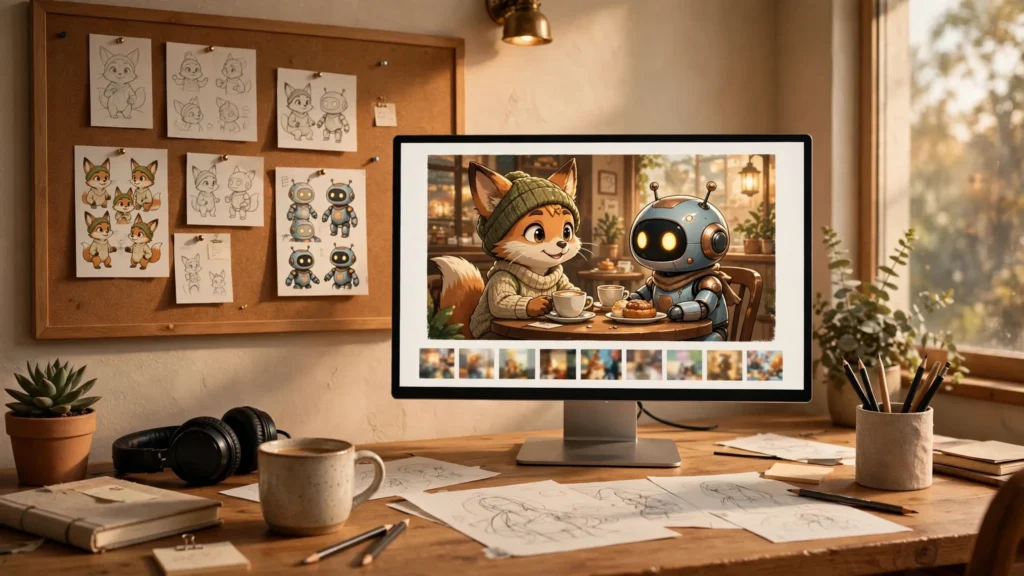
One character in a shot is a consistency problem. Two characters is a negotiation — and the model is negotiating on behalf of neither. Put two people in a generated scene and you get the genre’s signature failures: faces that borrow each other’s features, the taller character shrinking between shots, both leads slowly converging into similar-looking cousins — and my personal favourite, the shot where they’ve politely swapped hair.
Keeping multiple people distinct in AI video is its own discipline. Separate from single-character consistency. And it starts before the first frame is generated.
The good news: two-character scenes respond well to design. Pairs that are built to differ survive generation. Pairs that differ only in name do not. This guide covers why models merge people, how to design pairs with real contrast, blocking that keeps characters separable, the honest case for one speaker per shot, reference sets for two leads, and when to build the scene from single-person shots and let the edit do the meeting.
Why Models Merge People
A video model does not contain your characters as separate stored objects. It contains a soup of visual features — and your prompt asks it to serve two distinct people from that soup at once. Features leak. The beard thins on the man who has one and shadows in on the man who doesn’t. Hair colours slide toward each other. Two faces described with overlapping words get pulled toward a shared average. And most pairs of protagonists ARE described with overlapping words — because most protagonists are the same demographic.
Several forces drive the merge:
- Shared descriptors. “A man in his thirties” twice in one prompt is one instruction, not two. Whatever you do not differentiate, the model will tend to unify: similar build, similar hair, similar face structure.
- Proximity. The closer two figures stand and the more they interact — handshakes, embraces, passing objects — the more their pixels negotiate, and negotiation means borrowing. Contact between characters is where limbs and features cross-contaminate worst.
- Attention economics. The model renders most carefully whatever the prompt emphasises. In a two-person shot described mostly through one character’s action, the other becomes a lightly supervised background person — and unsupervised faces drift toward the nearest attractor, which is often the lead standing next to them.
- Shot-to-shot re-casting. Neither character is stored between generations, so each new shot re-derives both from the references and text. Two re-rolls per shot means twice the drift opportunities of a single-character scene, plus the pair’s relationship — heights, distance, sides — re-rolled as a bonus.
None of this means avoiding two-character scenes. It means engineering them. The same reference discipline that holds one character — covered in character consistency in AI video — is necessary here. But it’s not sufficient. Pair work needs contrast and blocking on top.
Contrast Is A Feature: Designing Pairs That Differ
The single most effective two-character decision happens at design time: make the pair maximally distinguishable along axes the model can see. This isn’t about making characters visually loud. It’s about giving the model — and the audience — separate buckets to put features in.
The axes that separate pairs best, roughly in order of reliability:
- Silhouette and build. Tall and slight against shorter and broad. Shape reads at any distance, in any light, even in a wide shot where faces are suggestions. Two leads with the same build will fight all series; two with different builds sort themselves.
- Hair. Colour, length and style together are the strongest facial-region separator. Dark long hair against short grey hair is nearly merge-proof; two brown mid-length heads of hair will trade features all day.
- Wardrobe palette. Give each lead a colour family and keep them out of each other’s. He is always in blues and greys; she is always in warm tones. Palette separation keeps identity readable in wide shots where faces are not, and it makes drift obvious in review — if the warm-toned character has gone cool, you see it instantly. Think of it as the wardrobe system used as an identity tool, not just a continuity one.
- Age, skin tone, facial structure. Real differences in face shape — strong jaw against soft, long face against round — give the model separate attractors to land on. Where the story allows, a generation gap between characters is one of the most stabilising design choices you can make.
What if the story needs two similar people — siblings, colleagues in uniform, a couple matched on purpose? Then the differentiators have to be deliberate and carried everywhere: one wears glasses always, one has the distinctive jacket, their hair parts on opposite sides, and the prompts name the distinguishing feature every single time (“the sister with the cropped hair” — never just “the sister”). Similarity is a legitimate creative choice. It just costs more rigour. Know you’re paying it before the series starts.
Blocking: Distance, Height And Screen Sides
Blocking — where bodies are in the frame — is a consistency tool, not just a storytelling one. Stable blocking gives each character a territory. And models keep identities cleaner when the territories are clear.
Three blocking habits that pay off:
- Keep them apart unless the story brings them together. Characters standing at conversational distance with clear air between them generate far more stably than characters shoulder to shoulder. Touching, hugging and fighting are the highest-risk interactions in two-character generation; write them as short, deliberate moments, not defaults, and expect a higher re-roll budget for them.
- Lock the height relationship. Decide who is taller and by roughly how much, note it on both character sheets (a shared frame with both standing together is the gold standard reference), and state it in prompts when both appear: “she is noticeably shorter than him.” Without this, relative height re-rolls per shot, and height is something audiences register without knowing they do. A pair whose height gap breathes from shot to shot feels subtly seasick.
- Assign screen sides and keep them. In conversation, one character owns frame-left looking right; the other owns frame-right looking left. In two-character work this discipline does double duty: it keeps eyelines honest and it gives each generation a positional definition of who is who. When a take comes back with the sides swapped, that is your earliest, cheapest signal that identities may have swapped too — check the faces on any side-swapped take with suspicion.
Seated-versus-standing is another quiet stabiliser: a height and posture difference built into the furniture of the scene (one at the desk, one in the chair opposite) restates who is who in every frame without prompt effort. Use the room.
One Speaker Per Shot, Honestly
Now the honest part. The most reliable two-character dialogue scene in AI video is usually built from single-character shots: one person speaking per shot, the other present as an over-shoulder edge, a reaction cutaway, or simply off-screen. Creators resist this because it feels like a limitation. Right up until they compare failure rates.
Consider what a true two-shot asks of the model: two stable faces, two distinct identities, synchronised believable performance, correct eyelines both ways, no feature trading, for the full clip. A single-speaker shot asks for one face performing while the second character is a shoulder and the back of a head — the least identity-loaded way a person can be in frame. And here’s the kicker: the over-shoulder shot is not a compromise invented for AI. Film and television have cut dialogue this way for a century because it works dramatically. The audience watches the listener’s reaction while hearing the speaker. Reactions are where scenes live.
My working pattern for a dialogue scene:
- One establishing two-shot, wide enough that faces are small — identity risk is low at distance, and the shot’s job is geography: who is where, in what room.
- Singles and over-shoulders for the actual exchange, one speaker per shot, with the listener’s shoulder or profile anchoring the frame.
- Reaction cutaways from the listener to cover joins, trim failures, and give the scene rhythm.
- Return to the two-shot only for beats that need both faces at once — and generate those short, with the pair’s full reference set loaded.
This structure also rescues your schedule: singles are cheaper to fix, eyelines are easier to control one direction at a time, and a failed reaction shot doesn’t take the speaker’s good take down with it.
Reference Sets For Two Leads
Each lead needs their own complete reference set — front, three-quarter, back and full-body views, an itemised outfit panel, expressions — built with the rigour covered in the reference images guide. Two-character work adds a shared layer on top of the individual sets:
- A together frame. Both characters in one image, standing at correct relative height, in their respective palettes. This single frame teaches more about the pair’s relationship than any paragraph: the height gap, the build contrast, the colour separation. Where the tool allows, it rides in the reference set for two-shots.
- Named references in the prompt. Do not write “the two characters from the references.” Write who is who and which reference governs whom: “Maya (reference 1) on the left; Daniel (reference 2) on the right.” On Seedance 2.5, with multiple reference slots, this labelling measurably reduces swaps; on any tool, it costs nothing.
- Per-character locked strings, both pasted, always. A two-character prompt carries two full identity blocks and two wardrobe lines. It is long. It is supposed to be. Trimming one character’s description because “the reference should cover it” is how the trimming shows up on screen three shots later.
Generate order matters too: establish each character alone first — their solo shots approved and saved as known-good references — before attempting the pair together. Debugging a merged two-shot is miserable. Debugging it when you also don’t know whether each solo identity is stable? Worse. Stable singles first, then the pair.
When To Build The Scene From Single-Person Shots
Sometimes the right call is to never generate the two characters together at all. Build the scene entirely from singles, over-shoulders, and inserts — and let editing create the meeting. Choose this route when:
- The pair keeps merging. Some combinations — similar builds, similar hair, a story that dresses them alike — tax certain models past the point of economy. If three honest attempts at a two-shot have all traded features, believe the evidence and restructure.
- The dialogue is long. The longer characters share frames, the more merge opportunities accumulate. Extended conversation is singles territory; save true two-shots for short, high-value beats.
- One character is much harder to generate. An unusual design, an elderly character, heavy styling — pair them in the edit with the easy character rather than letting the hard one’s instability poison every shared frame.
Building from singles does demand honest eyelines and geography — the scene has to feel like one room — which is storyboard work: the storyboard-first workflow is where the pair’s sides, eyelines, and the room are fixed once, so a hundred separate generations all point at the same invisible meeting. Audiences are extraordinarily good at assembling two people into a conversation from singles. After all, that’s how most of the conversations they’ve ever watched were filmed. They only notice when the geography breaks — not when the two-shot is absent.
Two characters in AI video stay distinct the way stage actors stay distinct: designed contrast, disciplined positions, and staging that doesn’t ask for more togetherness than the moment needs. Build pairs that differ, give each a side and a palette, lean on singles for the talking, and keep a together frame as the pair’s contract. The model will still try to merge them occasionally. With this system, occasionally is a re-roll. Not the series norm.