
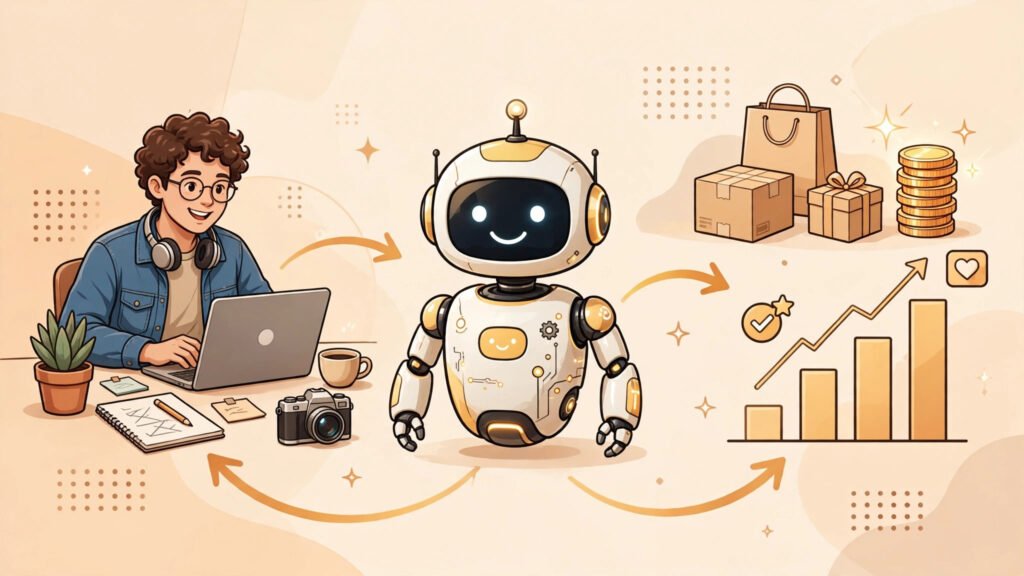
I’ve been in this game a long time — YouTube since 2010, Facebook since 2017 — and I’ve watched affiliate marketing go through every hype cycle imaginable. Crypto guys shilling courses. Dropshippers. And now AI video.
I’ll be straight with you: most of what’s out there about “AI affiliate marketing” is garbage. Either someone’s selling a $997 course, or it’s fantasy from someone who’s never sold a thing. This isn’t that. I’m going to explain how this actually works — the real mechanics, realistic timelines, and the costs nobody puts in their thumbnail.
The Model in One Paragraph
Stripped down? You pick a product that pays commission. You make videos that convince people to buy it. They buy, you get paid. That’s it. That’s the whole model.
AI just changes the “make videos” part. Instead of filming yourself like it’s 2019, you generate the footage — Seedance, Veo, whatever tool you’re using — slap on a voiceover (yours or AI, doesn’t matter much honestly), edit it, post it. Done.
But here’s what people get wrong. Everything else? Picking products. Earning trust. Getting traffic. Getting paid. That all works exactly like affiliate marketing has always worked. The AI doesn’t sell anything. You sell. The AI is just your production crew — the cameraman who never sleeps and doesn’t charge overtime.
And if you remember one thing from this whole article, make it this: the people failing at AI affiliate marketing are failing at the marketing part, not the AI part. Their videos look fine! Great, even. But nobody trusts them. Nobody clicks. Or — and this is the big one — they’re promoting products nobody actually wants. Fix the fundamentals first. The AI is just leverage on top of something that already works.
The Three Pieces: Product, Video, Traffic
Every affiliate setup that actually makes money — mine, yours, anyone’s — has three pieces. All three have to work. One breaks? The whole thing breaks. Simple as that.
Piece 1: The product (and the program behind it)
You don’t get paid by vibes. (I wish.) You get paid by an affiliate program — Amazon Associates, some software company’s partner program, a TikTok Shop product, Gumroad, whatever. They give you a unique link, a commission rate, and a rulebook.
Commission rates? All over the map. Physical products — think Amazon — often pay single digits. Like, 3-4%. Software and digital products? 20-50%, sometimes more. I’m not telling you what you’ll earn (anyone who does is lying), I’m just telling you the range these programs operate in.
What I’ve figured out — after picking some real duds, by the way — is that the product has to be something you can actually show on video. Sounds obvious? People miss this constantly.
A video-first affiliate does best with visual products. Something you can unbox, compare, show a before/after. A project management SaaS? Brutal on video. A skincare device where you show actual results? Way easier. Not because commissions are better — because one gives you something to point a camera at and the other gives you a login screen.
Piece 2: The video
Okay, this is where AI walks in.
Old school affiliate video meant filming yourself — unboxings, reviews, tutorials, talking-head recommendations. Still works, honestly. But with AI, you generate the footage instead. Product shots. Lifestyle scenes. Even a presenter who doesn’t exist.
The formats that work are the same ones that always worked. Reviews. Demos. Comparisons. UGC-style clips. Production method changed. Psychology didn’t.
What AI actually changes: speed and cost. A product demo that needed a camera, lighting, the physical product, and a shooting day? Draft it in an afternoon now. More tests, more formats, faster learning.
What it doesn’t change: you still need a hook in two seconds. You still need to understand the product. The viewer still needs to believe you. I’ve seen AI affiliate videos that convert beautifully — and gorgeous ones that sell zero. Difference was never render quality. It was trust.
Piece 3: Traffic
A video nobody watches earns nothing. Obvious? Sure. But people spend three weeks perfecting their AI workflow and zero minutes thinking about distribution. That’s backwards.
Traffic comes from platforms — YouTube, TikTok, Instagram Reels — each with different rules. YouTube rewards watch time and search intent (someone typing “best budget microphone” is already shopping). TikTok and Reels? You’re interrupting a scroll. First frame earns the second frame, or you’re gone.
Most beginners obsess over AI tools and ignore distribution. Distribution is the business. The video is just the product. A mediocre video with great distribution beats a perfect video nobody sees. Every time.
How Commissions Actually Get Tracked
Boring part. But you need this, because it’s where beginners stare at their dashboard going “I got 500 clicks but zero sales, is the tracking broken?”
Probably not broken. Let me explain.
When you join a program, you get a unique affiliate link. Sometimes called a referral link. It’s just a normal product URL with a tracking parameter stuck on the end — something like ?ref=yourname or a shortened redirect. Someone clicks it, the program drops a cookie in their browser (or logs it server-side), and now that visitor is tied to you. If they buy within the cookie window, you get credited.
Cookie windows vary a lot. Amazon? 24 hours. Brutal. Some programs give you 30, 60, even 90+ days. Longer windows favor considered purchases — software, courses, expensive stuff people think about before buying.
Few things I learned the hard way:
- Clicks are not sales. A 2% conversion rate — two buyers per hundred clicks — is normal to good in most niches. Getting traffic but no commissions? It’s usually product-audience mismatch or a weak call to action. Not the tracking. The tracking is almost never the problem.
- Cookie windows matter more than people think. That 24-hour Amazon window means someone has to buy fast. If your audience researches for a week before buying, you’re sending Amazon free traffic. Pick programs whose windows match how your audience actually buys.
- Attribution is usually last-click. Someone clicks your link, then clicks someone else’s link before buying? You lose it. That’s normal. Don’t build your strategy around edge cases.
- Payouts have thresholds. Most programs pay monthly once you cross a minimum — usually $10 to $100. Your first payout taking 60-90 days from your first sale? Completely normal. Don’t panic.
What AI Changes (and What It Doesn’t)
The hype is loud here. Let me cut through it.
What AI genuinely changes:
- Production speed. I can storyboard, generate, and edit a product demo in a day. Used to take a week. More tests, more formats, faster learning. This is the real advantage.
- Production cost. No camera gear. No studio rental. No buying every single product you want to review. (But — and this is important — you still need to understand the product. Deeply. More on that in a sec.)
- Format flexibility. One script becomes a YouTube review, three TikToks, and a Reel. Repurposing is basically free when generation is cheap.
- You don’t have to show your face. For people who will never film themselves — and that’s a lot of people — this removes the single biggest barrier. Huge.
What AI does NOT change:
- Trust. Nobody buys because footage was AI-generated. They buy because they believe the recommendation. Trust comes from specificity, admitting flaws, and showing up consistently. No shortcut.
- Platform rules. TikTok, YouTube, Instagram all have policies on promotional content. And FTC disclosure rules? They apply whether you filmed it on an iPhone or generated it with AI. No exceptions.
- The math. Commissions = traffic × conversion rate × commission value. AI doesn’t bend that equation. It just lets you take more swings at it.
- Product knowledge. Okay, uncomfortable truth time. The best AI affiliate videos I’ve seen? Made by people who deeply understood the product. Specs, competitors, real drawbacks — all of it. AI can’t research for you. If you don’t know the product, the video feels hollow. Doesn’t matter how pretty it looks. Hollow is hollow.
Realistic Timelines: What to Expect
I’m not giving you income figures. Anyone who does is selling something — probably a course. But timelines? I can give you those, because they’re about process, not promises.
Days 1–30: You’re learning. Setting up accounts, picking a niche, making your first videos, figuring out what your workflow even looks like. Expect zero commissions. That’s not failure, that’s normal. If someone tells you they made money in week one? They got lucky or they’re lying. Probably lying.
Days 30–90: You’re publishing consistently now. Starting to see which videos get traction. Maybe your first clicks show up. Maybe — maybe — your first sale. Most people quit here. The numbers are small and it feels pointless. But the numbers are supposed to be small. You’re still testing. This is the tuition phase.
Days 90–180: Patterns emerge. You know which formats get clicks, which products your audience responds to. Compounding kicks in — old videos earn while new ones stack on top. Funny thing: this is where most “overnight success” stories actually started. Months earlier. Invisible.
Beyond 6 months: If you’ve published consistently, actually studied your analytics (not just glanced at them), and kept improving? You’ve got a real asset. A library of videos earning while you sleep. A workflow that produces new ones efficiently. That’s the actual goal — not one viral video, but a system.
The variable nobody controls? The algorithm. A video can sit at 200 views for three months and then explode overnight. Or never move at all. You manage this the same way I do — volume, consistency, and not getting emotionally attached to any single video. The video is not your baby. It’s a lottery ticket you made yourself.
The Costs Nobody Mentions Upfront
“AI makes it free!”
No. No it doesn’t. Let me list the real costs so you’re not blindsided:
- AI generation credits. Video generation isn’t free at volume. Depending on your tool and how much you produce, budget for a monthly sub or credit packs. I’ve broken down realistic numbers in my AI video cost guide — go read it before you start.
- Your time. Biggest cost. Nobody prices it. Researching products, writing scripts, generating footage, editing, posting, analyzing — a single good affiliate video is hours of work even with AI handling the visuals. Anyone who says it’s “passive” is skipping the part where you work your butt off first.
- Editing software. You still edit. Premiere Pro, CapCut, DaVinci — pick one, learn it properly. AI generates clips. Editing turns clips into videos that actually sell. Different skill. Still required.
- Test budget (optional). Some creators boost early videos with small ad spend just to test faster. Not required. But it’s a real cost some people carry.
- The learning curve. Your first 20 videos will be worse than your next 20. That’s tuition. Everyone pays it. No exceptions, including me.
Your First 30 Days: A Sane Starting Plan
Alright. If I were starting from zero today — no audience, no videos, nothing — here’s exactly what I’d do:
Week 1 — Foundation. Pick ONE niche. Join 2-3 affiliate programs. Study the top 10 videos in your niche — not to copy, but to understand formats. Set up your AI workflow: generator, voiceover approach, editor. Zero videos this week. Research week.
Week 2 — First videos. Make 3-5 videos. They’ll be rough. Post them anyway — perfectionism is the enemy here. Focus on ONE format (I’d start with short product demos or UGC-style clips — fastest to produce, fastest feedback loop). And add proper FTC disclosures from day one. Not day 30. Day one. Build the habit, not the masterpiece.
Week 3 — Volume and variation. Post daily if you can manage it. At least 4-5 videos. Try two different formats side by side. Start tracking: which videos get views? Which get clicks? (Check your affiliate dashboard, not just view counts.) Where do people drop off? Your analytics are your teacher now. Listen to them.
Week 4 — Double down. Look at the data honestly. Whatever format got the most engagement — make more of that. Kill what’s not working. No sentimentality. And write down your workflow. The steps, the prompts, the checklist. So video #30 takes half the time of video #5. That’s the system forming. That’s the whole game.
That’s it. No secrets, no hacks. Pick a niche, learn the tools, publish, read the numbers, improve. AI is your production crew — you’re the director, marketer, and owner. Sounds like work? It is. The people who treat it like work are still earning a year later.
Want the tactics? Start with AI UGC videos for affiliate marketing — highest-demand format in this space right now. Or go faceless with my realistic faceless playbook. And if you skipped the basics, start here first.