
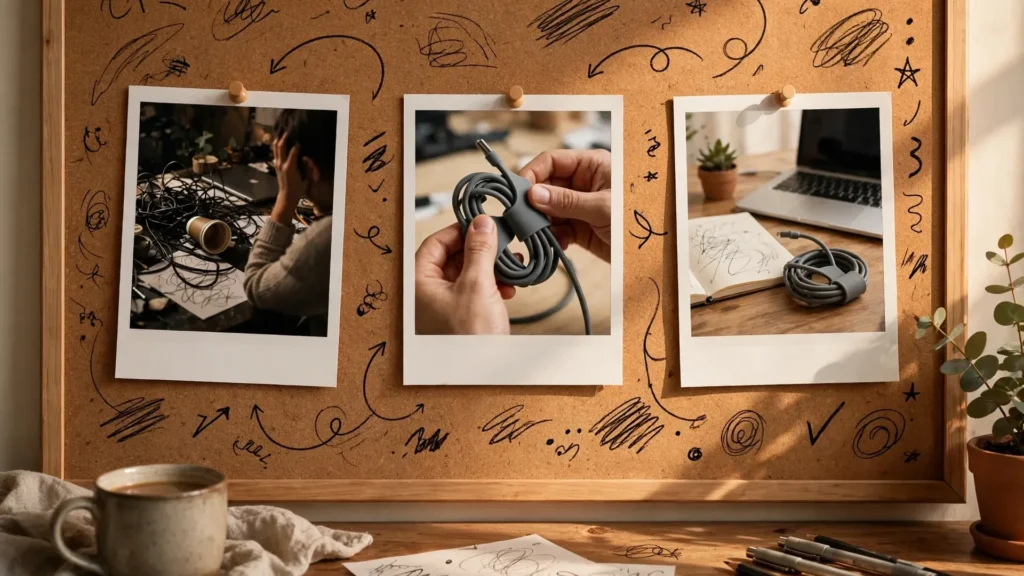
A client once sent me a product video they’d generated themselves and asked why it wasn’t converting. The video was, shot by shot, lovely: the bottle gleamed on a marble counter, steam curled off a cup beside it, golden light slid across the label. It was also completely interchangeable with a video for any other bottle ever made — and it never once showed what the bottle did, why it existed, or what life looked like on the other side of buying it. It was a portrait session for an object. Pretty is the default output of AI generation. Type a product name, get a beauty shot. Persuasion is something you have to direct.
The structure that persuades is old, simple, and maps beautifully onto AI’s strengths: problem, demo, proof. Three shots, three jobs. The problem makes the viewer feel a familiar frustration. The demo shows the product answering it in a way that can be believed. The proof shows the result living in the world after the demo ends. This guide walks each shot in turn, covers how to generate the arc without the product melting, warping, or quietly redesigning itself between shots — and finishes with timing maps for fifteen and thirty seconds.
Pretty Is Not Persuasive
Beauty-shot product videos fail for a reason worth understanding: the viewer has no question in their head when the product appears, so the product has nothing to answer. Advertising research said this in the print era, and the feed era has only sharpened it — attention follows tension. A gleaming bottle answers the question “what does it look like?” Which nobody was asking at 11pm while scrolling in bed. A soaked gym bag asks a question the viewer recognizes from their own life. And now a bottle that stays dry is interesting.
AI tools make this trap deeper, because beauty is literally their path of least resistance. “Premium product photography, dramatic light” is the most-trained aesthetic on earth — the model will produce it half asleep. Meanwhile “frustrated cyclist discovering his third leaked bottle this month” is a story beat the model will only produce if you direct it. Left to defaults, your product videos will drift toward the perfume-ad end of the spectrum. And perfume is nearly the only category that can sell on aura alone. Everything else sells on a problem solved.
There’s a production reason too. Pretty single-shot videos offer the editor nothing: no before to cut from, no after to cut to. The arc structure gives you a beginning, a middle, and an end the viewer can feel. And in AI terms, it gives the product three distinct appearances, each art-directed for its job, instead of one long heroic clip where consistency slowly unravels. Structure isn’t just rhetoric here. It is render management.
Shot 1: The Problem, Felt
The problem shot shows a recognizable frustration before the product enters — or at most, with the product failing in its ordinary form. The key word is felt. A stated problem (“leaks are annoying”) does nothing; a shown problem triggers the viewer’s own memory. The wet bag. The dead phone at the festival’s best moment. The salad dressing on the shirt in the taxi. Pick the version of the problem your audience has personally survived — and show its worst half-second, not a general mood of inconvenience.
Generation notes for problem shots. Keep the product out of frame one — or present only as the failing generic version: an old bottle, a rival’s vague shape. This protects your hero product for its entrance and avoids teaching the model two product designs at once. Faces help enormously here: frustration is a facial emotion, and a close reaction of “not again” sells the problem faster than any mess. But keep the action legible bigger than the emotion — the spill must read at phone size before the wince does.
- Make the problem cost something visible. Ruined clothes, a missed moment, a mess to clean. Cost is what creates the itch the demo will scratch.
- Keep it to one problem. A bottle that leaks and is heavy and tastes of plastic dilutes all three. One wound, treated well.
- Set the problem in the real habitat. Gym bags, desks, trails, school runs — wherever the product will be claimed to work, the problem should already live there.
Duration discipline: in short-form, the problem earns two to four seconds and not a frame more. You’re striking a match, not building a fireplace. If your problem needs setup, choose a problem that doesn’t.
Shot 2: The Demo, Believed
The demo is where the product does its thing — and where AI product videos most often cheat, usually without meaning to. A generation that shows the bottle “being leakproof” by simply not leaking in a static shot demonstrates nothing. Belief comes from witnessing a test: the bottle dropped, shaken, squeezed, inverted, frozen, thrown in the bag and pulled out after the run. The viewer must see the challenge and the survival in the same shot — or in tightly cut sequence — with the product visibly the same object throughout.
That last clause is the technical heart of product AI work. Demos involve handling — hands gripping, turning, opening — and handling is where generated products morph: labels slide, caps change shape, proportions breathe. Workarounds from my own production:
- Build a product sheet first. Just as characters get reference sheets, products get them: clean images of the product from front, side, and three-quarter, consistent light, no hands. Anchor every demo generation to these references, the same discipline covered in using reference images for consistency, applied to an object.
- Generate the demo as stills-then-motion for critical manipulations. If the cap must twist open, art-direct that exact mid-action frame as an image, check the geometry, then animate briefly. Hands interacting with a locked still fail far less than hands improvising around a text-only product.
- Choreograph simple tests. Drops, shakes, pours, wipes, single twists. The more mechanical the action, the more believable the generation and the more convincing the demo. A product surviving an AI-rendered obstacle course of simple abuses persuades better than one surviving a single impossible stunt — viewers can smell an impossible stunt, and AI stunt physics still smells synthetic.
- Keep hands brief. Hands enter, perform the test, exit. Lingering hand-product contact is where morphing accumulates; snappy handling reads as confidence anyway.
The demo should also quietly carry the brand facts: the label readable at least once, ideally in a beat of stillness inside the action — the bottle landing upright after the drop, label to camera, held for twelve frames. That pause is your packshot hiding inside the story, and it converts better than a tacked-on end card because it arrives at the moment of maximum belief.
Shot 3: The Proof, Remembered
Proof is not a second demo. Proof is the world after: the bag opened to dry contents, the phone still alive at the headline set’s final song, the shirt spotless at the meeting. It shows the benefit as a state of life rather than a product feature — and it’s the shot viewers actually remember, because humans store outcomes, not mechanisms. When someone describes your video to a friend, they’ll describe the proof.
The strongest proof shots rhyme with the problem shot. Same bag, same framing, opposite state. This bookend does two things: it makes the improvement visible by direct comparison (the audience doesn’t need to be told anything), and it builds the loop — the proof ending near where the problem began nudges replays, because the viewer wants to check the difference. The endings guide in this series goes deep on loops and bookends; in product work, the rhyme is doubly valuable because it also re-displays the product in its natural habitat, now associated with relief.
Include a small surplus in the proof — the extra thing beyond dryness: the unhurried smile, the friend borrowing the bottle, the product pulled out and used again immediately for something else. Surplus turns satisfaction into desire. And keep the proof honest in scale. AI makes it trivially easy to show impossible outcomes — a wallet-sized bottle hydrating a marathon — and audiences now discount impossible proof on sight. The believable win, slightly under-claimed, outsells the miracle.
One practical proof habit: hold it longer than feels necessary. The problem was fast, the demo was busy, the proof is where the viewer exhales. In a 15-second arc I routinely give proof a full third of the runtime. Editors trained on pure entertainment tend to cut it short. Resist. Remembering takes a beat.
Generating The Arc Without Melting The Product
Consistency is the tax on all AI product work, so here’s the condensed production system. First, the product sheet described above, made before any scene generation, using the cleanest product imagery you have — photograph the real product if it exists, from three angles, plain background. Second, a fixed product description string reused verbatim in every prompt (“matte black steel bottle, silver cap, minimal white logo band near the base”) so text and image anchors agree. Third, a shot order that front-loads risk: generate the demo first, because it’s the hardest; build problem and proof around the demo’s winning takes rather than regenerating the demo to match them. Hardest-first is a general principle I lean on across formats — it’s also why the prompt-to-final-cut workflow plans every generation on paper before the first render.
Lighting deserves a specific warning. Models love re-lighting a product for each scene’s mood, and a bottle that goes from soft morning light to neon nightclub between problem and proof reads as two products even with perfect geometry. Fix the product’s light description in your prompt string, and when scenes demand different light, prefer to move the scene light toward compatibility rather than re-inventing the product’s. In the edit, a unifying grade across the three shots covers a multitude of small sins — the same trick the character work uses, and for the same reason: consistency is partly manufactured in the grade.
Finally, generate alts for the proof only. The problem and demo usually have one correct shape, but proof shots benefit from options — two or three endings, same rhyme, different surplus. Pick after you see them in sequence. It’s the cheapest creative insurance in the whole arc, and endings are where options pay.
The AI B-roll guide is a good companion here, because problem and proof shots often need small environmental details — the gym interior, the festival crowd at a distance — that are B-roll’s home ground, generated cheaply as stills-in-motion so your credits stay on the product.
A 15-Second And A 30-Second Arc Map
The 15-second map, built for a single product claim:
- 0–3s, Problem: the soaked bag, the wince. One shot, product absent or generic.
- 3–10s, Demo: two or three escalating tests in quick cuts — drop, squeeze, bag-rattle — each one to two seconds, label beat in the middle.
- 10–15s, Proof: the dry bag bookend, product lifted out, small surplus (used immediately, or handed to a friend), held to the end.
The 30-second map, for a claim that needs a little story:
- 0–5s, Problem with a face: a person, a situation, the failure lands on them personally — the trail runner, the dead bottle at mile nine.
- 5–18s, Demo as mini-story: the product introduced by a hand (a friend’s, a coach’s), then tested across the situation’s real demands in three beats of rising difficulty, each beat a separate generation cut on the action.
- 18–30s, Proof as outcome scene: the finish line, the bag opened dry, the product in the final frame beside the person it saved — and the story closes on the person, not the logo. People remember who got rescued; the product gets remembered as the rescuer.
Notice what never appears in either map: a glamour shot for its own sake. Beauty is welcome inside the demo and proof — the label beat, the final held frame — where it is doing persuasion’s work. On its own? Wallpaper.
So before your next product generation, write three sentences: the felt problem, the believable test, the remembered outcome. Build the product sheet. Generate the demo first. Rhyme the proof with the problem. That arc is older than television. It survives translation to any generator shipping this year or next. And it turns a bottle’s portrait session into a small story with a point — which is the only kind of product video that has ever sold anything.