
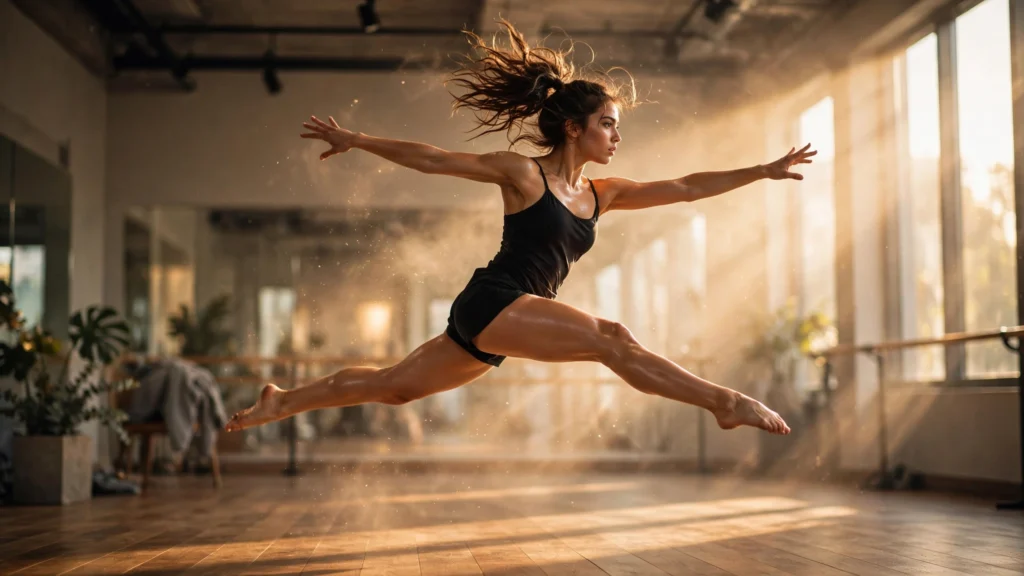
If your clip looks dead, the verb is usually the problem. Not the model, not the seed, not the resolution. The verb. I learned this the expensive way in my own pipeline — I’d write a beautiful subject line for a storyboard panel, get the light right, get the framing right, and then type something soft like “moving through the market” and wonder why the generation drifted instead of walked. “Moving” tells a model almost nothing. “Striding,” “drifting,” “squeezing past,” “pausing” — those tell it how a body should behave frame to frame.
In a storyboard-first workflow this matters even more, because the board already made the decision. Every panel in my Seedance work has one action written on it before I ever open the prompt box. The prompt doesn’t invent movement. It inherits the verb from the board, word for word. When I skip that step and improvise verbs at generation time, the take rate drops. When I respect it, the same model suddenly looks more obedient. The model didn’t change. The instruction did.
This is a practical guide to choosing verbs models can actually execute. Not magic words, not a copied list from someone else’s prompt dump. Just the families that work, the pace words that help, and the verbs that reliably break things.
Verbs Are Instructions, Adjectives Are Wishes
Here’s the split I use when I review a prompt before spending a generation. Verbs are instructions. Adjectives are wishes. “Gracefully” is a wish. “Slowly” attached to a real verb starts to become an instruction — but even then, it needs the verb to do the heavy lifting.
Compare these two lines:
“A dancer moves beautifully across the stage.”
“A dancer glides across the stage, arms extended.”
The second line isn’t prettier writing. It’s more filmable. “Glides” implies continuous contact, low friction, extended lines, no sharp stops. The model has a physical pattern to follow. “Moves beautifully” gives it a compliment and a direction, and models are bad at taking compliments literally. They average them out into generic sway.
The same problem shows up everywhere. “A car drives fast down the road.” Fast how? Weaving? Launching? Cruising? Each verb produces a different camera feel, a different blur, a different risk of the wheels melting. “A car accelerates away from the curb” gives the model a start point and a change in speed. “A car cruises along a coastal road” gives it a steady state it can hold for eight seconds without inventing drama. The verb is doing cinematography before the camera instruction even arrives.
In my pipeline, I test a verb by asking a dull question: could an animator keyframe this? If the answer is yes — you can picture pose one, pose two, and the path between them — the verb is probably safe. If the answer is “sort of, it depends on the mood,” the verb is too abstract. “Yearning,” “celebrating,” “vibing” — none of these keyframe cleanly. “Reaching,” “turning,” “lifting,” “leaning” do. Models, for all their sophistication, still need the same clarity a junior animator would need.
That doesn’t mean stripping your prompts down to robotic commands. It means putting the poetry in the nouns and the light, and keeping the verbs physical. Let “rain-soaked neon street” carry the mood. Let the verb carry the motion.
The Verb Families: Travel, Gesture, Object Motion
After a few hundred generations, the verbs that survive sort themselves into three families in my notes. I keep them separate because each family fails differently, and each one wants different support from the rest of the prompt.
Travel Verbs: Bodies Moving Through Space
These move a subject from one place to another: walk, stride, run, sprint, wander, approach, retreat, cross, climb, descend, circle, pass. Travel verbs are the most sensitive to camera framing. A “walk” in a wide shot reads cleanly. The same “walk” in a tight close-up often turns into shoulder bounce and face drift, because the model is trying to show leg motion it can’t see.
What actually works is pairing the travel verb with a destination or a surface. “Walks toward the market stall” holds better than “walks.” “Climbs the concrete stairs” holds better than “climbs.” The destination gives the motion an end point, and end points are what keep travel verbs from looping or wandering off the storyboard. In Seedance especially, I’ve found that a travel verb without a destination will invent one — usually straight at the camera, whether I wanted that or not.
Speed lives inside the choice here. “Strolls,” “walks,” “strides,” “hurries,” “runs” are not synonyms. They’re five different clips. Pick the one that matches the board. If the board says the character is tired, “trudges” or “drags his feet” will get you closer than adding “tiredly” to “walks.”
Gesture Verbs: Bodies Moving In Place
These are the workhorses for character shots: turn, look, glance, nod, shake (as in shaking the head), wave, point, reach, shrug, lean, sit, stand, kneel, fold, unfold. Gesture verbs are where believable acting lives, because most story beats aren’t travel. Someone hears a sound and turns. Someone decides something and looks down. Someone hesitates before they reach for a cup.
Gesture verbs want a direction and often a target. “Turns” alone will spin people in surprising ways. “Turns toward the door” or “turns to face camera” gives the model a finish line for the rotation. “Looks” is weak on its own. “Looks up at the sign,” “glances over her shoulder,” “looks down at his hands” — each of these produces a different head angle, a different eyeline, a different feeling. In a Premiere timeline, eyelines are what let cuts feel continuous. If the verb didn’t specify the target, the edit can’t save it.
My honest rule: one gesture verb per shot is plenty. Two gestures in sequence — “she turns, waves, and walks away” — is where models start blending. The turn smears into the wave, the wave smears into the exit. That’s not a model flaw to complain about. That’s a prompt asking for three shots inside one generation. Board it as three shots and the problem disappears.
Object Motion Verbs: Things Moving Without A Person Driving Them
Steam rises. Rain falls. A flag flutters. Water pours, drips, splashes, settles. A door swings, slides, slams, creaks open. These verbs carry scenes where no character is acting, and they’re also the background life that makes a character shot feel inhabited instead of staged.
Object verbs reward physical accuracy. “Water moves in the glass” is vague. “Water sloshes as he sets the glass down” ties the motion to a cause. “Curtains move in the wind” works, but “curtains billow inward from an open window” works better — because billow describes a shape change, not just displacement. Models track shape changes surprisingly well when the verb names them.
Watch out for object verbs that imply complex physics chains. “Dominoes fall and knock over a glass which spills across the table” is three physics events that each need contact to resolve. Break the chain or accept the melt. For B-roll and establishing shots, single object verbs — rising, falling, drifting, flickering, pooling — are the reliable earners.
If you’re building your camera language alongside your verbs, the guide to camera movement in AI video prompts pairs well with this one, because travel verbs and camera moves either cooperate or fight. A “slow push-in” while the subject “sprints toward camera” is two accelerations stacked. One of them should yield.
Pace Words That Ride Along: Slowly, Sharply, Gently
Pace words are adverbs, and I just spent a section telling you adverbs are wishes. So why keep them? Because a small set of pace words genuinely changes execution when they ride on a solid verb. The trick is knowing which ones earn their place.
The reliable ones describe how a movement unfolds in time: slowly, gradually, steadily, abruptly, sharply, gently, hesitantly, repeatedly. Each of these maps to something a model can vary — acceleration, duration, smoothness, repetition. “Slowly pushes the door open” really does produce a different clip from “pushes the door open.” The door takes longer to travel the same arc, the hand stays in contact longer, the whole beat breathes. That’s usable.
The unreliable pace words describe how a movement should feel to a viewer: beautifully, elegantly, dramatically, sadly, happily. These don’t change the physics. They change nothing measurable, so the model either ignores them or translates them into a default sway or an oversized expression. “Sadly lifts the cup” doesn’t produce a sad lift. It produces a lift with a frown glued on, if you’re lucky.
My working limit is one pace word per verb, and I place it directly against the verb, not floating elsewhere in the sentence. “She slowly turns toward the window” beats “she turns toward the window in a slow, dreamy, cinematic way.” The first version gives the model one timing instruction. The second gives it a mood board and hopes for the best.
There’s also a negation habit worth copying. Instead of stacking pace words to correct a too-fast generation, change the verb first. If “runs” keeps coming out frantic when the board wants urgency without panic, try “jogs,” “hurries,” or “moves quickly” before you add “calmly, smoothly, not too fast” to “runs.” Verb swaps fix pace at the root. Adverb stacks just argue with the root.
Shot duration interacts with pace more than most creators expect. A “slowly” verb inside a five-second generation may barely start before the clip ends. The same verb inside a ten-second generation has room to complete. When a slow action keeps getting cut off mid-gesture, the fix is often a shorter journey, not a different adverb. Ask for less distance, less rotation, a smaller reach — then “slowly” has a finish line it can actually reach.
Verbs That Break Models (And Their Safer Synonyms)
Some verbs break models so consistently that I keep a substitution list pinned next to my shot lists. These aren’t forbidden words in some moral sense. They’re just expensive. Each one tends to demand either invisible causes, complex contact, or abstract intent.
- “Thinking,” “realizing,” “remembering,” “deciding.” Nothing on screen corresponds to these. Safer: show the visible beat — “pauses, looks down at the photo,” “stops mid-step, turns back.” Let the viewer infer the thought.
- “Dancing” (unqualified). Full-body rhythmic motion with no specified pattern often turns into flailing. Safer: name the pattern at postcard scale — “sways side to side to music,” “spins once with arms out.” Smaller claim, cleaner render.
- “Fighting,” “wrestling,” “struggling.” Two bodies in sustained contact is the hardest thing in current generation. Safer: stage the moment before or after contact — “raises a hand to block,” “stumbles back.” The edit can imply the rest.
- “Building,” “assembling,” “fixing,” “cooking” (as whole processes). These are minutes-long processes compressed into seconds, so the model samples random stages and blends them. Safer: pick one stage — “tightens a screw,” “stirs the pot once,” “places the final piece.”
- “Transforming,” “morphing,” “becoming.” Deliberate shape change invites uncontrolled shape change everywhere else too. Safer: cut. Generate state A, generate state B, let the transition live in the edit where you control it.
- “Interacting” and “playing.” Vague social verbs. “Two children playing” gives the model no specific contact to choreograph. Safer: “one child rolls a ball toward the other” — one verb, one object, one direction.
Notice the pattern in the safer synonyms. They’re smaller, they’re visible, and most of them could be drawn as two storyboard frames: a start pose and an end pose. That two-frame test is the same test I apply to new verbs before they enter my working vocabulary. If I can’t draw the before and after, I don’t ask a model to invent them in motion.
There’s an honest trade-off here. The safer verb is almost always the less exciting verb on paper. “Stumbles back” sounds smaller than “fights off the attacker.” But the small verb produces a usable shot, and the exciting verb produces a discard. In a production pipeline, usable beats exciting every time, because the exciting moment can be built from three usable shots in Premiere. It can’t be built from one melted hero generation, no matter how ambitious the prompt was.
For the prompts where you know a risky verb is unavoidable — a handoff, a pour, a bite — the shot-specific guidance in the negative prompts guide helps you fence off the worst artefacts, but the first fix is still the verb choice. Negatives clean up after a decision. They rarely rescue a bad one.
Building Your Personal Verb Bank By Shot Type
Generic verb lists copied from the internet age badly, because they aren’t tied to the shots you actually make. What’s lasted in my own work is a small personal bank, organized by shot type, built from generations that survived the edit. It started as a note on my phone. It’s still mostly that note, just tidier.
Build yours in four columns, one per shot type you use most. For a story creator, those columns might be: portrait beats, two-person beats, product/contact beats, and environment beats. For a product creator, they might be: tabletop, hands-on, lifestyle, and packshot. The columns matter less than the habit of filing verbs where you’ll reach for them mid-project.
Under each column, keep ten to fifteen verbs that have actually worked for you, each with a tiny note about its condition. Not “walk — good.” More like “strolls — wide shot only, melts in close-up” or “glances — needs a named target or the eyes wander.” Those conditions are the real knowledge. Anyone can list verbs. The conditions tell future-you when to trust them.
Add to the bank only from approved shots. A verb that produced one lucky generation in twenty is not a bank verb; it’s a lottery memory. A verb that produced usable footage three times in a row, across different subjects, has earned its place. This is the same discipline as the storyboard-first workflow itself — approve at the cheap stage, promote only what survives review.
Retire verbs too. Models change. A verb that broke constantly last year may be safe now, and a verb you relied on may get worse after an update shifts the motion priors. Once per project, I scan the bank and mark anything that’s failed twice in a row for re-testing on a throwaway generation before I trust it in a real shot. Five minutes of testing has saved me more credits than any settings tweak.
Start the bank with the verbs from this article if you like, but don’t stop there. The next time a generation surprises you — in either direction — write down the exact verb you used while you still remember it. That note, repeated over a month of real work, becomes a vocabulary fitted to your subjects, your model, and your editing style. No downloaded list can give you that, because no downloaded list has seen your footage.
The closing thought is unglamorous, and it’s the one that actually improved my output: motion problems are usually verb problems wearing a settings costume. Before you change the model, the seed, or the guidance, reread the verb. Swap it for a smaller, more physical cousin. Give it a destination. Give it one pace word at most. Then generate again. Half the time, that single word was the whole fix — and now it costs you one word instead of one afternoon.