
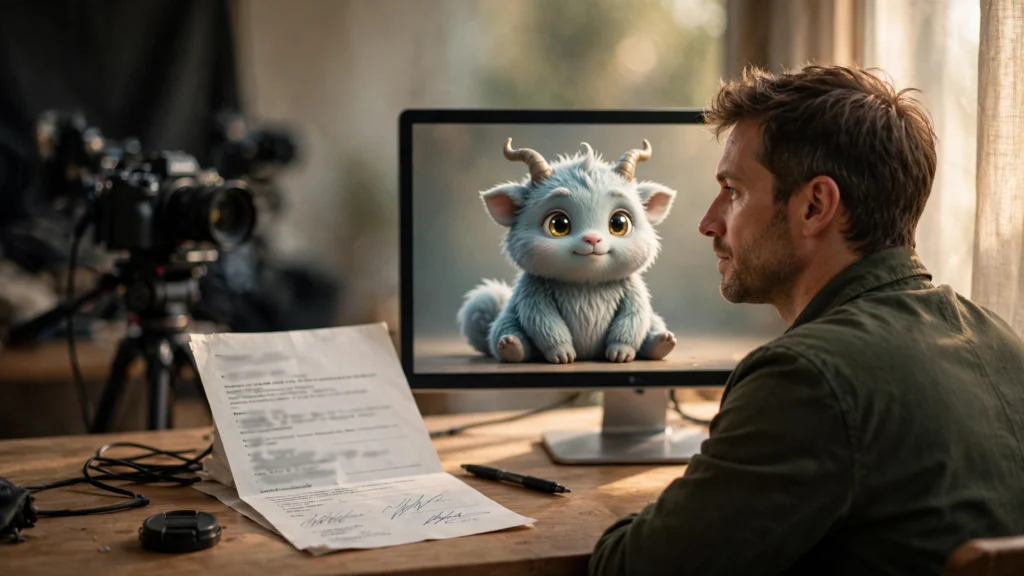
The request usually arrives like this: a client loves a clip, then asks, “Can we just make it her?” Her is an influencer they can’t afford. An actor from a reference video. Or occasionally the client’s own competitor. Sometimes it’s a creator asking about their own channel: can they put a famous face in the thumbnail generation, just for the click? The generation takes ninety seconds. The trouble it can start lasts a lot longer — and it does not care that the face came out of a model instead of a camera.
Working with real people’s likeness in AI video is where this craft stops being only a craft question and becomes a people question. Who agreed to this? Who profits from it? Who gets harmed if it spreads? Here’s how I think about it after years of client work and channel work, and where my hard lines sit. This is general information from a creator’s workflow, not legal advice — likeness and publicity questions are fact-specific, and worth real counsel when money or a real person’s reputation is on the line.
Your Face, Your Call: The Basic Principle
Strip away the technology and the principle is old: a person’s face and voice are theirs. Using someone’s recognizable likeness — especially to sell something, or to put words in their mouth — generally calls for that person’s permission. Lawyers discuss this under names like right of publicity and privacy rights, and the details shift by place and situation. Which is precisely why a working creator should operate on the simple version: recognizable real person plus no permission equals do not ship it. Simple.
The AI part changes the method, not the principle. A camera needs the person in the room. A model needs only a few reference frames — which makes the temptation stronger and the excuse weaker. “The model generated it” is not a defense anyone finds persuasive when the output is plainly a real, identifiable human. If a viewer can name the person, treat the clip as containing that person. Because everyone else will — the person, their manager, the platform, the audience.
Your own likeness is the clean exception. And even that deserves a moment of thought. You can consent to your own face and voice, obviously. But decide deliberately where your synthetic self may appear — because a consented workflow today becomes training references and project files that sit in folders for years. Folders you’ll forget about until you don’t.
Public Figures Are Not Public Property
This is the single most common misunderstanding I correct. Fame changes how much privacy a person can expect from photographers and headlines. It does not hand creators a license to manufacture footage of that person. A celebrity endorsing your fictional energy drink in a generated ad. A politician delivering a speech they never gave. A beloved actor placed in scenes they would never have agreed to. These are the canonical bad uses — and each one is bad for stacked reasons: commercial exploitation of likeness, deception of the audience, and harm to the person’s actual livelihood and dignity.
What about commentary, parody, and news-style content, where real public figures legitimately appear in editorial work all the time? Context genuinely matters here, and editorial uses of real people’s images have real protections in many places. But those protections were built around reporting and commentary on actual events — not around fabricating photoreal performances. A video essay criticizing a public figure, illustrated with clearly framed commentary, is a different animal from a generated clip of that figure “caught” doing something. The closer synthetic content gets to faking evidence, the thinner the ice gets. Editorial label or not. My practical rule for channel work: public figures may be discussed, quoted from real footage under normal editorial judgment, and depicted in obviously stylized, non-deceptive ways. They may not be made to act, endorse, or confess.
Clients, Actors And Paid Consent
The good news: consent is a solved problem when you treat it like production paperwork instead of a vibe. In client work and in my own projects with collaborators, this is what consent that actually holds up looks like:
- Written, specific, and signed before generation. The agreement names what will be created: the person’s likeness and/or voice, in AI-generated video, for named uses (for example, one campaign, named platforms, a set period). “We can use your stuff” in a chat message is not this.
- Scope the person would recognize. Would the person, watching the finished clip, feel it matches what they agreed to? If the honest answer is “they’d be surprised,” the consent did not cover it, whatever the paper says.
- Payment and credit settled upfront. Paid consent is normal professional practice, the same as hiring the person to perform, because that is what you have done — you have hired their identity as a performer.
- Revocation and takedown terms. Decide in advance what happens if the person withdraws: which posts come down, how fast, what paid media can run out its booked term. Writing this down while everyone is friendly is ten times easier than negotiating it during a dispute.
For actors and models you hire specifically as AI references, add one clause creators forget: what happens to the reference material itself. Your contract should say whether source photos and voice samples may be kept, reused for other characters, or must be deleted at the engagement’s end. People agree to be a character. They rarely agree to become a reusable asset library. Keep those separate and you keep your collaborators. The contracting mechanics connect closely to our client revision workflow guide — consent checkpoints belong in that pipeline at the storyboard stage, not after delivery.
Voice Cloning Someone Else’s Voice
Voice deserves its own section, because creators consistently underrate it. A face might render imperfectly and read as “inspired by.” A cloned voice lands instantly and personally. Audiences recognize voices — of presenters, actors, singers, and increasingly of mid-size creators — with an intimacy that makes unauthorized cloning feel like impersonation. Because functionally, it is.
My lines here are stricter than for imagery. Never clone a real person’s voice without their explicit permission. Not for a “tribute.” Not for a placeholder you swear will be replaced. Not for a client who swears they know the guy. Placeholders have a way of shipping. If a project needs a particular vocal quality, hire a voice actor whose contract includes synthetic use — or use a properly licensed synthetic voice whose terms cover your use. Our sound design guide covers building a voice and audio palette you own. There’s also a plain craft argument: a voice recorded or licensed for your project, directed by you, will outperform a borrowed identity stitched onto your script. And it’ll still be yours on the next project.
Platform Deepfake Rules And Strike Risk
Platforms treat synthetic depictions of real people as one of the higher-risk content categories. Their policies, stated generally, cluster around the same targets: deceptive impersonation, fabricated statements by real people, non-consensual intimate imagery (an absolute zero — in policy and in basic decency), and synthetic media passed off as real evidence. TikTok, YouTube, and Meta all require disclosure of realistic synthetic content, and all reserve removal and account penalties for the deceptive end of it. Election-related fakes and fraud uses sit at the most severe end everywhere.
What this means at the desk: a realistic deepfake-style clip carries strike risk that a stylized animation never will. And the risk attaches to your account, not to the one video. Channels have exactly one asset that can’t be regenerated — the account’s standing. So I storyboard accordingly. If a concept only works by faking a real person realistically, the concept gets redesigned at the paper stage, where redesigns are free. Our storyboard-first workflow exists partly for this: likeness questions get answered when the scene is still boxes and arrows.
Safe Alternatives That Still Get The Click
Refusing real likenesses does not mean refusing the click. The formats that tempt creators toward famous faces — recognition, borrowed trust, an expressive human performance — all have legitimate routes to the same effect:
- Build a recurring original character. A consistent, well-designed character of your own compounds recognition across videos the way a celebrity face does in one. Slower, but the asset is yours forever and nobody can revoke it.
- License the person, actually. Mid-size creators and local personalities say yes to paid, scoped synthetic appearances more often than people assume, because the money is real and the shoot day does not exist. Ask properly, in writing, like a production.
- Cast for the quality, not the identity. The client who wants “her” usually wants her warmth, timing, or authority. A hired performer, directed well and consented for AI reference work, delivers the quality without the borrowed identity.
- Go openly stylized. Caricature energy, animation, obvious artifice — used for commentary rather than deception — reads as creative choice instead of forgery, to audiences and moderators alike.
If you take one operational rule from this article, take the storyboard test: for every human figure in your boards, write one word beside them — mine, hired, licensed, or invented. If any figure can’t earn one of those words honestly, the board doesn’t advance to generation. It takes a minute per project. It happens while changes are still free. And it has quietly prevented more bad weeks than any policy page I’ve ever read.
Questions Creators Ask Me About Faces And Voices
What if the person is deceased, or historical? Death doesn’t tidy this up the way creators hope. In many places, likeness rights in some form can outlive the person. Estates and families do object. And platforms keep their own rules about depicting real people regardless. Historical figures in clearly educational, non-deceptive contexts are the calmest water here; a long-dead celebrity “endorsing” your product is not. Treat the deceased with the same consent logic and extra care — not less.
What if my generated character only kind of looks like someone famous? Then you have the worst version of the problem: close enough for audiences to name, messy enough that you clearly steered toward it. Nudge the design away — change the features, the styling, the context — until a viewer describes a type, not a person. And if commenters keep naming the celebrity anyway? The audience has given you the review your legal department would have.
Can I use my client’s own face in their ads? Yes — with the same written consent anyone else gets. Business owners cheerfully approve their own likeness on a call and think differently when a synthetic version of them says new lines in month nine. Scope it: which campaigns, what the likeness may say and do, review rights over each script, and what happens when the engagement ends. Owners deserve the paperwork too. And so do you.
The thread through all of this is respect operationalized as paperwork and restraint. Real people’s faces and voices made certain careers possible — including, frankly, audience trust in ours. Use your own likeness freely. Hire and document everyone else’s. Keep public figures in the realm of honest commentary. And redesign any concept that needs a fake human to work. The clicks you earn that way are the kind that stay earned.